
How To Navigate Digital Signage Advertising Rates?
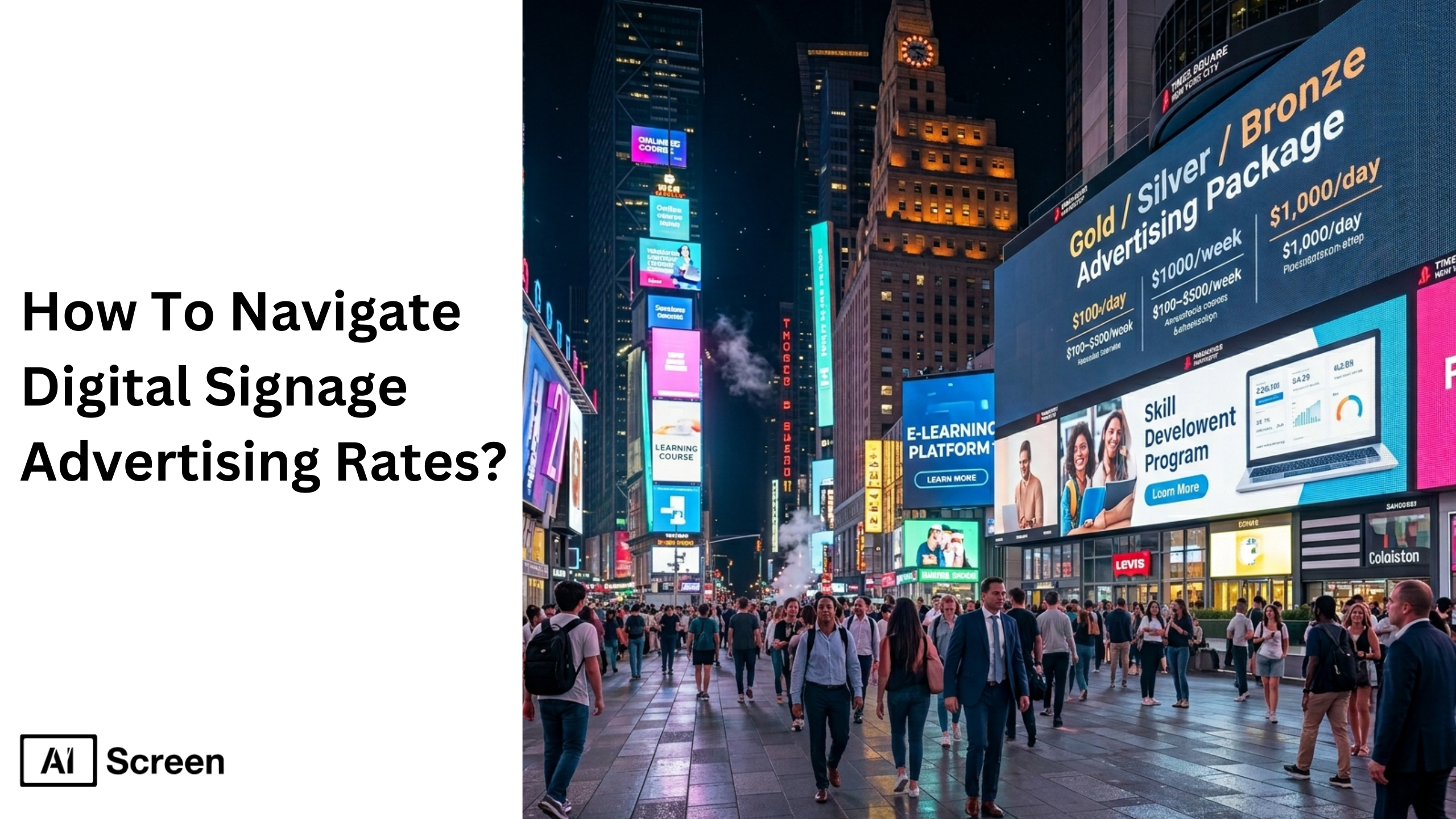
Navigating digital signage advertising rate vary by screen position, size, audience and frequency According to a 2024 study by OAAA and The Harris Poll, 79% of surveyed US adults aged 18–64 noticed digital billboard ads. This shows how visible digital outdoor advertising can be. However, the price of showing an ad changes from one location to another.
We have studied the research of industry organisations and published advertising rate cards to gain insight into these costs. In this guide, you will learn how digital signage advertising prices are influenced, how businesses can compare rates and what they should look for before booking advertising space.
What Is Digital Signage Advertising?
Digital signage advertising is known for utilizing LCD, LED and projection screens to display paid advertising. These displays are seen in shopping malls, airports, restaurants and transit stops. Businesses use them to advertise goods, post deals and get in touch with individuals in noisy locations. Digital screens can display a video, an animation and messages that will change from day to day, something that cannot be done on printed poster.
Digital advertising is additionally a fantastic method for getting businesses extra control over the timing of when their message is visible. For instance, a restaurant could offer breakfast in the morning and dinner offers later in the day. Screen owners use digital signage software to manage these changes across their displays. Our guide to advertising on digital signage explains how businesses can create and run these campaigns.
What Factors Affect Digital Signage Advertising Rates?
Digital signage advertising rates vary as not all the screens are created equal in terms of advertising opportunity. A display in a high traffic area such as in an airport can reach a greater number of people than one in a small office. But size of the audience is not the only part of the price. However, other parameters such as screen type, ad duration, display frequency, and additional services impact advertiser rates.
1. Positioning of the Digital Screen
One of the most important things that will affect rates for digital signage advertising is screen location. There may be greater value of how many people could potentially view an advertiser’s message in areas with higher foot traffic, and therefore advertisers may be willing to pay a higher price. But even a small screen can be a good investment provided it’s seen by the right crowd.
High-Traffic Areas
Airports, shopping malls and busy city centres are good places to attract advertisers as large numbers of people pass through them each day. It could be better to have screens close to areas – doorways or waiting rooms/check out counters – than to have screens in quiet corners. Ultimately, the cost will vary depending on the setting, the number of available ad space and how many people might be viewing the display.
Our AIScreen team reviewed the OAAA’s August 2026 industry report. It found that digital out-of-home advertising made up 38.4% of US out-of-home advertising revenue in Q2 2026. Additionally, digital revenue increased by 18.5% from the corresponding quarter of 2025. While these are estimates of the level of investment in digital advertising they do not define the individual screen price.
Targeted Locations
It can be smaller than an airport or the shopping mall – in gym, office buildings, waiting rooms. But these places can provide you a more targeted target market. So if you’re a fitness company, you might want to advertise in a gym as people in that area are already health and exercise enthusiasts.
Based on our AIScreen team’s research on advertising spots, we suggest that you consider the audience fit before comparing screens costs. A small sign in the right spot can be more helpful to a consumer than a big screen with lots of people moving around but little regard for the product the advertiser is selling.


2. Screen Size and Type
Digital signage advertising rates can also vary due to the size and resolution of the screens. Larger displays tend to be easier to see from a distance and smaller displays are effective at close range. The placement of a screen, however, is another important factor, as is the brightness and visibility of the ad.
Large-Scale Displays
Large LED displays and video walls are typically found along highways, in stadiums and bustling commercial locations. These screens are able to display ads to pedestrians or motorists. Although premium locations tend to cost more due to their visibility and demand, there’s no one confirmed weekly price for every large digital billboard.
Small to Medium Displays
Screens between 32 and 55 inches are often used in restaurants, retail stores and office buildings. These can feature product offers, area advertising, and short video ads. A small screen mounted in close proximity to a cashier might be the most effective way of capturing your customers’ attention versus a large screen in a place they don’t often stop to view.
Interactive and High-Resolution Screens
Interactive screens and 4K displays can help the customers view the detail images and interact with the content. These capabilities can prove valuable for product catalogues, product promotions and self-service experiences. But there’s no guarantee that higher resolution means higher advertising rate. The screen needs to be seen by the appropriate audience and not interfere with viewing.
3. Content Duration and Frequency
There is also a difference in digital signage advertising rates for length of an ad, and frequency of ad play. Most digital advertising networks have repeating playlists, which means that multiple ads can be used to fill the amount of screen time available. Businesses have options for varying ad lengths and when ads are displayed.
The AIScreen template designer and digital signage CMS together give full control over content, scheduling, and updates, making it one of the simplest and most powerful systems to manage without external services.
Duration
With the networks, an advertising slot can be 10, 15 or 30 seconds in length. Sometimes short ads are effective where folks don’t have time to digest information. If you are in a waiting room or waiting area where users are close to the screen for a longer period of time, then longer ads might be more appropriate.
For instance, the University of Illinois has digital advertising slots that are 10 seconds long on the screens located in Illini Union. This illustrates how certain venues have set ad durations (as opposed to ad lengths that can be up to the advertiser).
Frequency
Frequency is the number of times the ad is shown in an hour, day or week. Ad that appears every minute consumes more screen time than ad that appears after every 5 minutes. This may have an impact on the price, since the amount of schedule awarded to each advertiser can vary.
For instance, if an ad is set to show once every 5 minutes on a screen on for 12 hours a day, it will play 144 times each day. Over seven days, that would be 1,008 scheduled ad plays. This is a sample calculation rather than a published advertising rate. It also assumes the screen stays on and every scheduled play is completed.
Using AIScreen digital signage remote management helps optimize this by allowing companies to control screens remotely, monitor performance in real time, manage power schedules, and reduce ongoing maintenance costs. It ensures your system runs smoothly without manual intervention.
4. Audience Metrics and Analytics
When it comes to digital signage advertising, audience data can help advertisers determine if it is a good investment. Some networks measure foot traffic, estimated impressions and viewing time. This info can assist business owners make comparisons between various screen locations and determine where their advertising money’s best spent.
Using AIScreen digital signage analytics, businesses can track footfall, demographics, dwell time, and attention. This helps companies understand who sees their ads, when they engage, and how long they stay, making campaigns more data-driven and effective.

The IAB has released its Digital Out-of-Home Measurement Guide (July 2025) which was reviewed by our AIScreen team. The study clarifies the difference between an ad play and impression. So an ad play has occurred if the ad was seen on the screen. Impression is an estimate of an exposure based on whether the opportunity for exposure was reasonable.
For instance, a screen can be exposed to a particular advertisement 500 times in a campaign. This doesn’t necessarily mean that 500 people watched it. Before comparison of prices, advertisers need to determine how audiences are measured. Screen owners can also use an advertising network with campaign scheduling and proof-of-play reporting to check whether paid ads ran as planned.
5. Additional Costs
In addition to the placement itself, advertisers also might have to cover content, campaign setup and reporting costs. These charges are based on the service(s) provided in the booking. Businesses should request a break down of advertising expenses before accepting a quotation.
- Content Creation: Professional images, videos and motion graphics can be required to be separately designed. This will vary based on the length of the ad, style of the ad and the work required in preparing the ad.
- Software and Integration Fees: Certain companies charge for the setup of a campaign, content changes or content management.. Screen owners planning larger networks can compare the best digital signage software companies for building an advertising network to understand which tools support scheduling and reporting.
- Long-Term Discounts: Certain advertising providers supply rebates for contracts of a month or even more. However, discounts will be dependent on the provider and contract terms. Before making a long-term commitment, business houses should compare the total cost.
How Can You Maximize ROI on Digital Signage Advertising Rates?

The most important part of a good ROI is to pick the correct advertising spot and be proactive with the message you present. Often, the lowest priced screen is not the best choice. Advertisers should take into account who may see the advertisements, how often the advertisements may be shown and what they want people to do.
Our AIScreen team also reviewed the 2024 research by OAAA and The Harris Poll. Among recent digital billboard viewers, 27% reported accessing a coupon, discount code or other information through a QR code, swipe, tap or text method. This finding shows that digital billboard advertising can lead to measurable customer actions, although it does not guarantee the same results for every campaign.
Here are four tips on how to maximize digital signage advertising:
- Target the Right Audience: Select screens based on your customers’ interests and activities. Having a display without a lot of audience can be beneficial if the audience needs your product more.
- Invest in Clear Content: utilize compelling graphics, grab a reader with brief headlines and messages. Don’t put too much text in the display—particularly when viewers are in motion.
- Compare Advertising Contracts: nquire about ad frequency, length of advertising, and any additional terms before contracting. Discounted pricing for a longer campaign might be offered by some providers, but the overall expense should be within your budget..
- Use Analytics to Measure Results: View the number of ad plays and impressions to learn how your campaign is delivering. QR scans can be tracked as well as redemptions or other actions taken by the customer can be observed to understand how customers are reacting.
AIScreen team tip: We suggest that you conduct a small campaign first, and only then expand your budget. Initially, determine if the advertisements were done as expected. Then compare the customer response between each location. This will provide you with even more useful information than selecting a screen with traffic alone.
What Are Examples of Digital Signage Advertising Rates?
The prices for digital signage ads can differ from network to network and location to location. To determine actual examples of the cost of weekly digital screen advertising, we analyzed published price lists from US universities by our AIScreen team. Rates gathered from official website of the venues, not general rates.
| Location | Screen Details | Weekly Rate | Ad Duration |
| Binghamton University | 14 digital displays | $12 per request | 10–15 seconds |
| University of North Texas | University Union digital screens | $20 per ad | 10 seconds |
| South Dakota State University | 20+ digital displays | $45 plus design fees | 15 seconds |
| University of Illinois | Illini Union displays | $75 | 10 seconds |
Table: Signage advertising rates published on official university websites. These are “campus advertising programs” and have rules governing eligibility. Others are restricted to departments in the university or to particular student groups. They’re not typical ads rates from commercial advertising network.
These are examples of how the ad prices can vary depending on the venue, length of the ad and rules of booking. Shopping malls, airports, gym and transit stations can all be different for different reasons due to different numbers of people who visit shopping or advertising requirements. There is no one reliable weekly rate for all these locations in our AIScreen research. Advertisers should ask each venue for an up-to-date quote instead of taking an industry average which cannot be supported.
How Does Drone Aerial Advertising Compare With Digital Signage Advertising Rates?
Traditional digital signage is the type of signage that is present in stores, airports and public places in a fixed manner. Drone aerial advertising refers to the use of flying displays, banners or a LED system to present a brand message at an event. While both of these practices can be used to target consumers, there is a cost difference and the two practices require varying levels of planning.
Drone campaigns may require flight permits, equipment, trained operators and safety planning. Businesses interested in other outdoor advertising options can read our guide to drone aerial digital signage advertising. It provides an understanding of how the aerial campaign works and what factors impact on the cost of the campaign
How Can You Plan Digital Signage Advertising Rates With Confidence?
The cost of digital signage advertising is based on location, type of screen, reach of the audience and the frequency at which an ad is played. Businesses need to consider these factors when selecting a screen. A small advertising campaign can be more valuable than a costly placement, if it has a clear advertising message and targeted audience. Inquire for a full quote and find out what’s included in the advertising package.
Owners of digital screens can manage paid advertising with the use of campaign playlists and proof of play reports with the help from AIScreen. These assist screen owners in scheduling ads and viewing deliveries by location. Test a small campaign and check out the results before growing your advertising network.
FAQs
1. What Are The Average Digital Signage Advertising Rates?
The average for all digital displays is not set. The rates are dependent on the location, audience size and frequency of ad plays. Advertisers should get rate cards from multiple sources and get quotes for a particular site..
2. How Much Does Digital Signage Advertising Cost Per Week?
The weekly cost is dependent on the location of the screen and the advertising network. Certain university locations list prices ranging from $12 to $75 for certain university placements. Depending on audience reach, and frequency of display, commercial sites may charge more.
3. How Are Digital Signage Advertising Rates Calculated?
Typically rates are based on ad plays, fixed booking periods or CPM. CPM is the cost for every 1,000 estimated impressions. Some screen owners also impose fees according to the length of the ad and how many times the message appears.
4. What Factors Affect Digital Signage Advertising Costs The Most?
The primary ones are screen location, audience size, display type and ad frequency. High traffic locations can be more expensive. But a smaller screen that reaches the right customers can provide better value.
5. Can Small Businesses Afford Digital Signage Advertising?
Yes. Local screens and short campaigns are a good beginning for small businesses. There are some networks that provide options. By comparing prices and testing one location to begin with, businesses can help control their spending.
6. How Can Businesses Measure Digital Signage Advertising ROI?
Businesses can view proof of play reports, estimated impressions, QR code scans, and offers redemptions. These figures will indicate if the advertisements were run and how the audience reacted. But views of ads doesn’t necessarily indicate a sale was made through the ad.
