
How Can Wayfinding Hospital Signage Improve Accessibility?
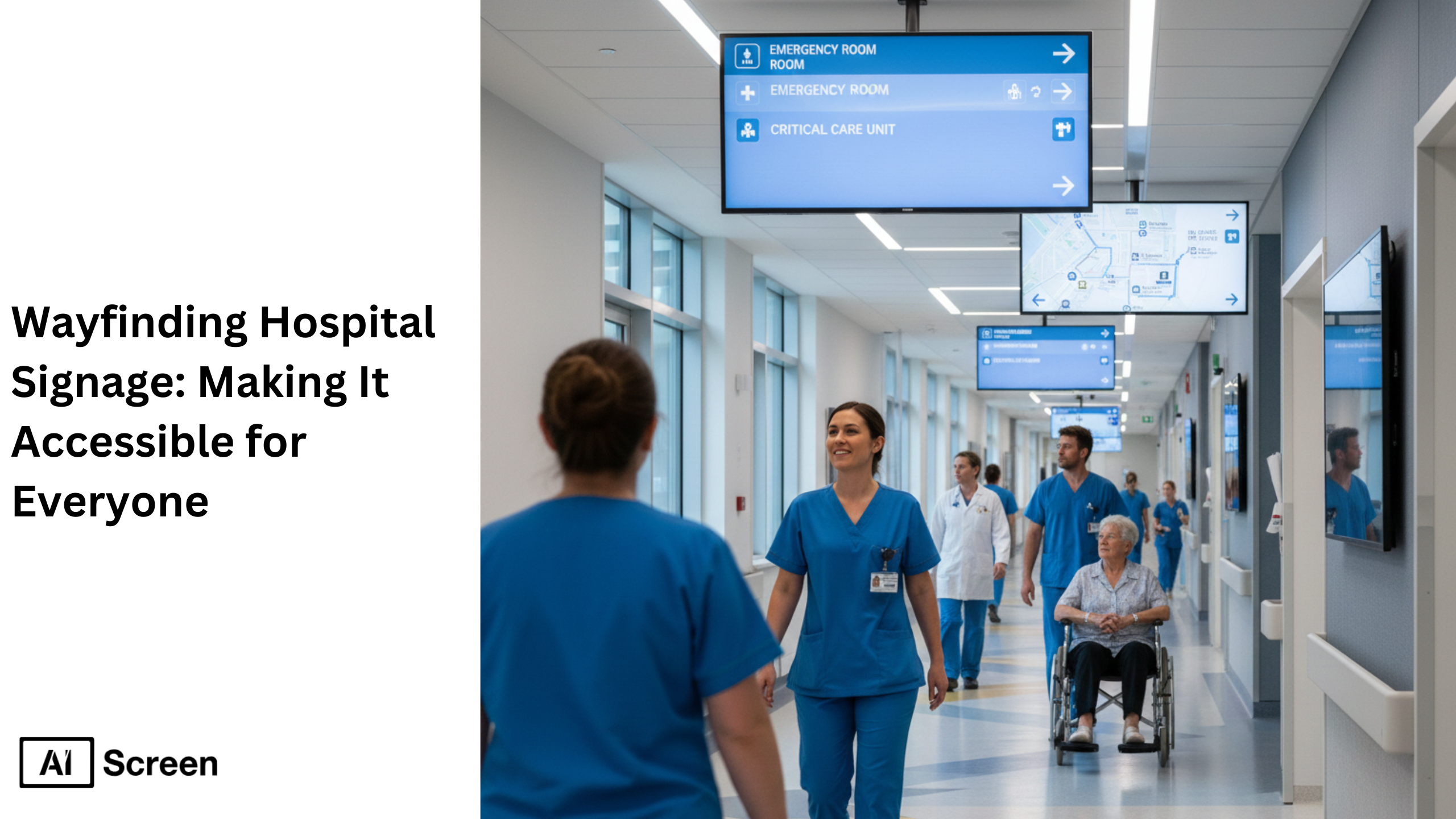
Hospitals are often complex, high-stress environments, and effective wayfinding hospital signage can dramatically reduce confusion, calm anxieties, and streamline patient flow, all while supporting staff efficiency. Clear directional signage helps everyone navigate the maze-like corridors of healthcare facilities, improving accessibility for people with mobility or cognitive challenges. A 36-month study in a large public hospital found that after implementing color-coded, multilingual signage, 98% of visitors could reach their destination, though many still double-checked with staff.
In this blog, we’ll explore why wayfinding signage matters in healthcare, what “wayfinding hospital signage” really means, and practical strategies, from tactile signs to digital wayfinding solutions, to make your hospital more navigable for patients and visitors. We also cover how modern digital signage displays can complement traditional signs, increasing operational efficiency and improving patient experience.
Modern facilities manage these displays with digital signage software so signage stays accurate and easy to update.
What is Wayfinding Hospital Signage?
Wayfinding hospital signage is a system of directional, informational, regulatory, and identification signs designed to guide patients, visitors, and staff through healthcare facilities. It blends visual elements (like color-coded maps and arrows), tactile and braille signage, and digital wayfinding solutions such as interactive kiosks and real-time digital screens.
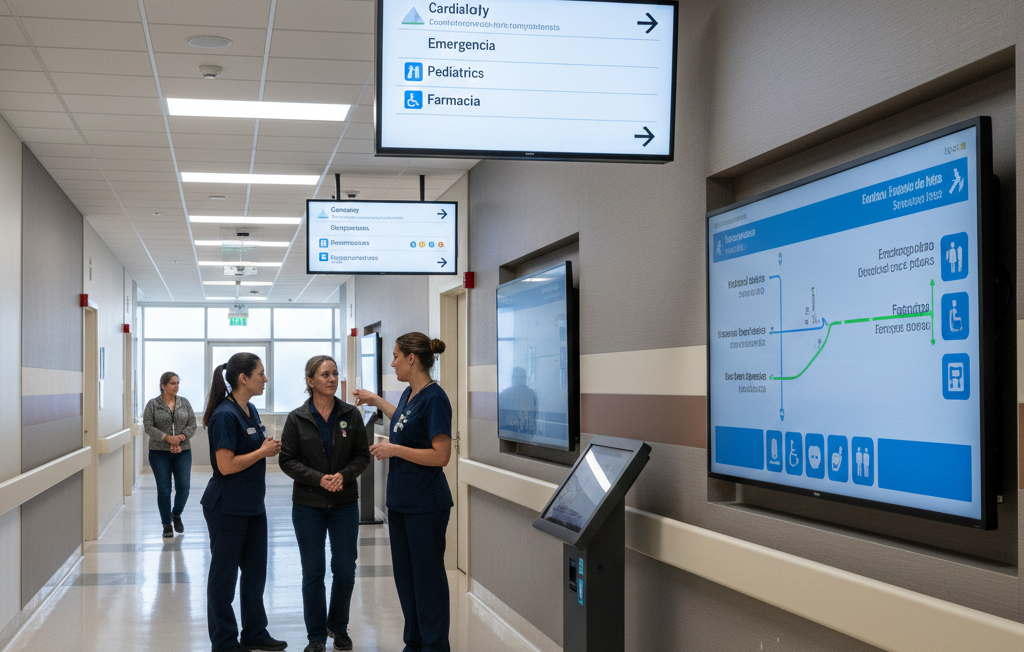
In many hospitals, signage systems must accommodate different abilities, tactile and braille elements help visually impaired users, while universally recognized symbols and high-contrast typography improve visual accessibility for all.
Digital screens can also show dynamic content (e.g., department maps, emergency alerts), making navigation intuitive.
Wayfinding is especially critical because according to NIH in sprawling healthcare facilities, 35% of decision-making points are poorly marked, leading to “misplacement of directional signs” and confusion.
Why Is Hospital Wayfinding Signs Important?
Hospital wayfinding signs are important because poor navigation can increase stress, delay care, and waste valuable resources. A well-designed wayfinding system is more than decor; it is an operational tool that improves healthcare signage, supports patient flow, and enhances the experience for everyone. Hospitals can also enhance digital signage wayfinding with real-time directions, department updates, interactive maps, and accessible navigation information that helps people reach their destinations more efficiently.
Hospitals are busy environments filled with patients, visitors, and staff who all have different needs and destinations. A well-planned wayfinding system can make a major difference by reducing confusion and helping people move through the facility with greater confidence. Here’s how:
1. Reducing Patient Stress
Reducing patient stress starts the moment someone enters a hospital environment. Patients often arrive at hospitals feeling overwhelmed.
Anxiety is common, especially among first-time visitors, elderly individuals, and those with mobility challenges. When someone enters an unfamiliar environment and can’t easily find their way, stress levels naturally rise.
Clear and thoughtfully placed wayfinding hospital signage helps patients feel more grounded and in control by guiding them visually and logically from point to point.
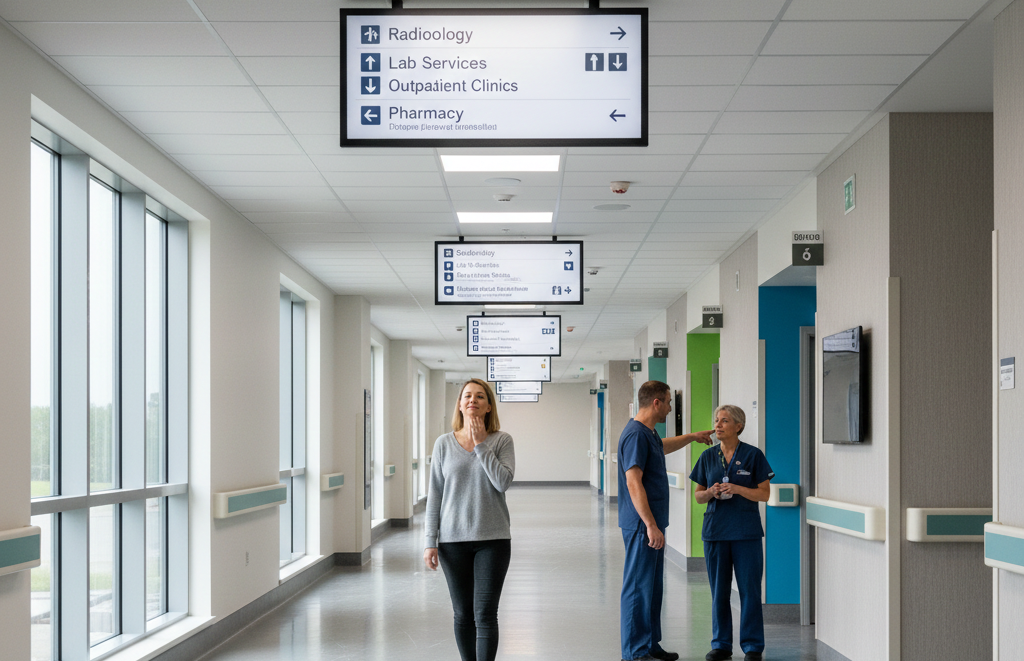
But here’s the real question, what if simply reaching the radiology department didn’t feel like solving a maze? Straightforward navigation can transform hospital visits from daunting to manageable.
When patients know exactly where they’re going, it reduces cognitive load, lowers frustration, and builds confidence. Intuitive wayfinding systems, supported by clear signage, allow people to navigate complex facilities without second-guessing every turn.
Effective hospital wayfinding signage isn’t just about directional arrows, it’s about creating a welcoming environment where design accommodates diverse patient populations, including those with visual impairments, mobility challenges, or language barriers.
Integrating tactile signage, universal symbols, and strategic placement at key decision points ensures equitable navigation across public spaces and healthcare facilities.
Most people don’t realize it, but effective wayfinding also contributes to reducing stress before appointments, helping patients arrive calmer and more prepared. Consistent design using sans serif fonts and a light background enhances signage accessibility, reduces the need to ask for help, and improves the overall patient experience, especially in overwhelming environments.
2. Saving Valuable Time
Saving valuable time inside a hospital directly impacts care quality and operational flow. Time is one of the most critical resources inside a hospital, where even small delays can affect care outcomes.
When patients and staff spend less time searching for departments, more time is available for appointments, critical procedures, and essential clinical responsibilities.
Accurate wayfinding strategies support smoother movement across multiple departments, helping every visitor and healthcare worker reach their destination efficiently.
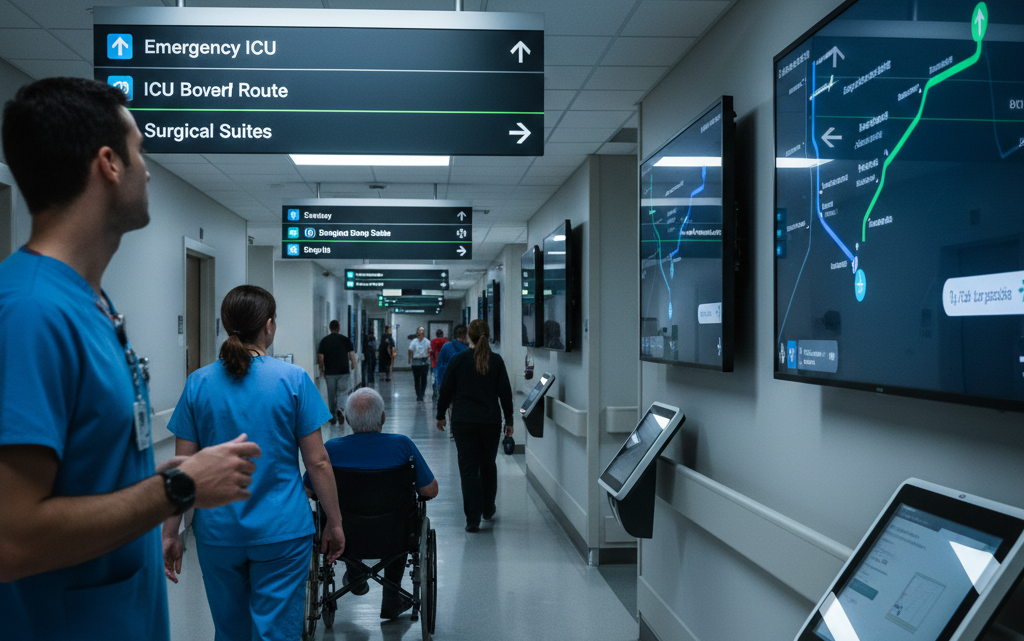
Here’s something worth pausing on, how much time could be saved if navigation didn’t depend on trial and error at every corridor? According to a 2021 study by the U.S. Department of Health and Human Services (HHS), inefficient navigation in large hospitals can lead to an average delay of 4.5 minutes per patient movement, directly impacting operational flow and care coordination.
This finding highlights the importance of well-structured signage for hospitals and optimized traffic routes within complex spaces.
Efficient wayfinding solutions, including digital directional signage, interactive kiosks, and step-by-step directions, streamline pathways between departments. They are especially valuable in emergency rooms and high traffic areas, where patient rushing can worsen confusion.
A strategically designed wayfinding system minimizes unnecessary detours and interruptions, enabling faster decision-making.
For staff, less time spent redirecting patients and visitors means more time dedicated to patient care. In turn, this improves operational efficiency, supports better preparation for care transitions, and helps maintain a smooth flow across the healthcare facility.
Whether through static signage or real-time digital displays, modern signage systems support faster routing and improved coordination in complex environments.
3. Freeing Up Staff Resources
Freeing up staff resources begins by reducing unnecessary navigation-related interruptions. Hospital staff, particularly nurses and administrative teams are frequently interrupted by people asking for directions.
While usually helpful, these interactions take time away from medical duties and patient care. When hospitals incorporate clear signage supported by a well-planned hospital wayfinding design, patients and visitors can navigate independently, reducing repeated guidance requests and allowing staff to focus on core responsibilities.
Quick thought how often do your nurses answer the same “where is cardiology?” question in a single shift? Implementing well-designed wayfinding systems that include proper signage with tactile elements, ADA compliant signage, and consistent directional visibility dramatically reduces this burden.
Thoughtful wayfinding solutions also help people with visual impairments and cognitive accessibility challenges traverse complex environments with confidence.
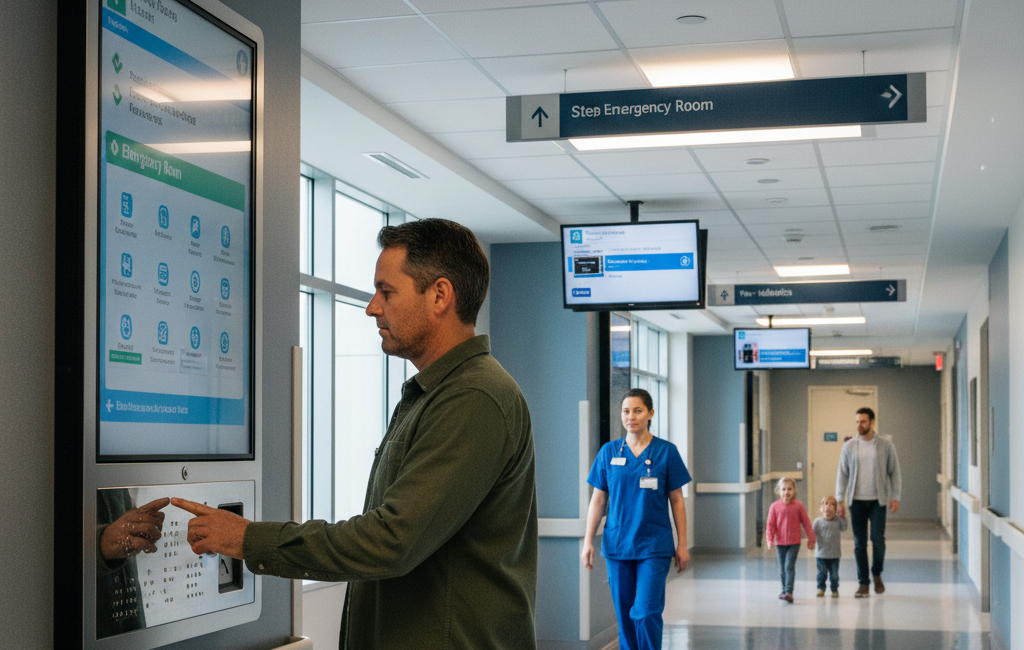
Integrating interactive kiosks, digital signage, and step-by-step directions within healthcare facilities provides autonomy to users, enhancing patient experience while improving staff efficiency.
Combining tactile signage for visually impaired individuals with clear graphic elements and universal symbols meets regulatory compliance and supports equitable navigation across public spaces.
Additionally, using effective wayfinding strategies boosts improve operational efficiency, minimizes navigation-related interruptions, and ensures people move through multiple departments without overwhelming decision-making moments.
In complex facilities where mobility challenges, language barriers, or unfamiliar layouts often slow people down, well-designed signage helps them navigate the space easily while staff concentrate on delivering quality care.
Whether implemented through static signage, digital screen networks, or hybrid signage systems, a strategic approach to hospital wayfinding plays a crucial role in reducing stress, enhancing safety, and allowing medical staff to do their jobs efficiently without constant redirection duties.


How Do You Improve Hospital Wayfinding Signs?
To improve your hospital directional signs, here are some practical tips. Even if your facility already has wayfinding systems in place, growing patient demands and expanding infrastructures, especially with an aging population, make it necessary to reassess how effectively people move through complex healthcare settings.
There’s always room to optimize effective wayfinding, improve the clarity of directional signage, and make navigation more intuitive and accessible for patients and visitors, including wheelchair users and those protected under the Disabilities Act.
Building a system that reduces stress and supports every journey, from registration to emergency rooms, requires a structured approach focusing on design, technology, placement, and accessibility-driven solutions. Here are some practical strategies.
1. Digital Kiosks: Interactive Navigation Tools
Digital kiosk, the interactive naviagtion tools are becoming increasingly popular and a major upgrade from static maps. These touchscreen stations provide detailed maps, search-based directories, and even step-by-step directions, allowing users to locate departments, physicians, and hospital services quickly.
Positioned strategically at entry points and key decision points, they enhance navigation systems by offering multilingual options and updates in real-time.
Isn’t it reassuring when you know help is only a screen tap away? Introducing a digital kiosk ensures patients and visitors, including those experiencing mobility challenges, can access fast guidance without needing staff assistance. These tools also support safer transitions during high traffic areas or emergency evacuations, making them a crucial role in modern hospital wayfinding systems.
2. Signage: The Core of Effective Wayfinding
Clear, well-structured directional signage is the backbone of effective wayfinding across any healthcare setting. Consistent typography using sans serif fonts, high contrast backgrounds, and readable arrows ensure people instantly identify the correct route.
To support inclusivity, combine ADA compliant signage, tactile elements, auditory cues, and multilingual translations for visitors with diverse communication needs.
Here’s something to consider, what if one small design change could prevent hundreds of wrong turns each week? According to a 2022 study by Harvard School of Public Health, hospitals with consistent wayfinding signage and clear visibility reduced navigation-related delays by 28%, directly improving efficiency and patient arrival times.
This data further highlights why proper placement, high contrast layouts, and consistent design are essential. Complement physical displays with digital signage systems in waiting areas to communicate emergency signage, real-time updates, and department routing when needed.
3. Thoughtfully Designed Pathways
This is where the principles of design elevate navigation from functional to intuitive. Consider implementing color-coded pathways, recognizable landmarks, distinct lighting patterns, or floor graphics to differentiate departments.
Used strategically, colors can help patients and visitors recognize zones faster, especially when navigating multiple departments in complex facilities.
Pause for a moment, have you ever remembered a direction because of a color or symbol, not a room number? These visual markers reduce cognitive load, enabling people to move through public spaces with greater confidence. When combined with a structured wayfinding system, color zones serve as powerful key elements for orientation, guiding people seamlessly across the facility.
4. Optimizing Sightlines for Easy Visibility
This critical aspect is often overlooked but plays a vital part in improving hospital wayfinding systems. When planning renovations or layouts, ensure directional signage is visible from a reasonable distance and free from obstructions.
Signs positioned slightly above eye level allow wheelchair users and standing visitors alike to maintain consistent visual tracking.
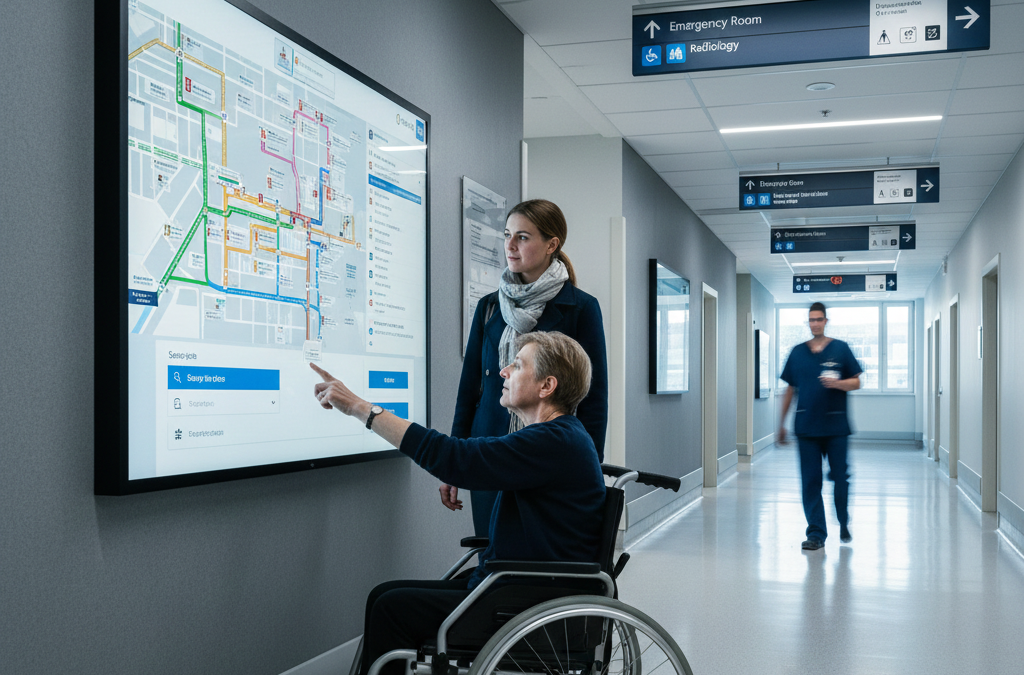
But can someone anticipate where to go before reaching a junction? Good sightline planning enables that. Think of it like urban design for indoor spaces, visible waypoints, unobstructed arrows, and corridor alignment help reduce hesitation and support quicker decision-making at navigation system transition zones.
5. Simplifying Navigation: Less Is More
It may seem counterintuitive, but minimizing choices actually makes navigation easier. Instead of presenting multiple ways to access the same location, design one primary, clearly marked route.
This creates a frictionless journey and reduces confusion at decision points, particularly valuable during patient rushing or emergency response moments.
Ever felt overwhelmed by too many options? The same happens with signage. Prioritizing clarity, hierarchy, and minimalism helps ensure smoother movement. Limit visual noise and focus on highly visible step-by-step directions to minimize misinterpretation and improve patient experience, even in daunting task environments like emergency triage.
6. Mobile Apps: Wayfinding at Your Fingertips
With smartphones everywhere, many hospitals now offer app-based wayfinding solutions. These tools incorporate indoor GPS, digital floor plans, and turn-by-turn routing for faster navigation.
They can also integrate QR-based map scanning, accessibility features, and voice instructions for people managing mobility challenges, visual impairments, or emotional stress.
Wouldn’t it be easier if the hospital simply guided you via your phone? These apps function like a virtual assistant, putting interactive navigation directly in patients’ hands. Combined with digital signage, they help reduce unnecessary inquiries, streamline traffic flow, and improve overall operational efficiency.
Why Switch to Digital Wayfinding Signage?
Healthcare environments are shifting rapidly from static directional signs to digital wayfinding systems due to their flexibility and responsiveness. Digital displays are not limited by physical placement and can quickly adapt during emergency routing, construction adjustments, or crowd control periods.
In fact, a 2023 Deloitte healthcare operations report revealed that hospitals using digital navigation aids improved patient directional accuracy by 34%, especially across expanded building networks and high-volume lobbies.
As facilities modernize their wayfinding strategies, these systems also create opportunities to clearly communicate safety information, including emergency guidance and compliance details, making it easier for visitors and staff to understand what are the categories of fire signage within complex healthcare environments.
Why Digital Signage Is Essential in Modern Hospital Wayfinding
Modern hospital navigation requires adaptability. Digital signage provides live updates on department wait times, emergency alerts, multilingual support, and traffic reroutes when needed. It enables adaptive routing during high-traffic periods, immediately informing visitors when entrances close or elevator access shifts.
Including solutions such as wayfinding digital signage allows hospitals to move beyond static arrows to dynamic guidance. As we already read in this article on wayfinding hospital signage, making it accessible for everyone, digital transformation ensures no visitor is left confused, regardless of ability or familiarity with the facility.
How Can Wayfinding Hospital Signage Improve the Signage of Hospital Spaces?
Effective wayfinding hospital signage plays a major role in improving the overall signage of hospital environments. Clear directional signs, department labels, room numbers, floor maps, and digital displays help patients and visitors move through complex healthcare facilities with less confusion. Consistent colors, readable fonts, and recognizable icons also make important information easier to understand at a glance.
Well-planned signage of hospital spaces should combine navigation, safety, accessibility, and communication in one coordinated system. By using wayfinding hospital signage at entrances, corridors, elevators, waiting areas, and key decision points, hospitals can create a smoother experience for patients, visitors, and staff while reducing unnecessary delays and questions.
Why Choose AIScreen for Hospital Wayfinding Signage?
AIScreen powers hospital wayfinding signage across every screen and kiosk, so patients, visitors, and staff can find departments, rooms, entrances, elevators, and other important locations with less confusion. From digital maps and directional displays to real-time updates, AIScreen helps healthcare facilities keep navigation information accurate, accessible, and easy to follow.
As a leading provider of digital signage solutions, AIScreen helps hospitals create smarter wayfinding experiences with centralized content management, remote updates, and flexible screen scheduling. Its cloud-based platform makes it easier to maintain consistent directions across large facilities while supporting a smoother, more organized experience for patients, visitors, and staff.
Start a free trial or book a demo to see how easy accurate, accessible navigation can be.
Frequently Asked Questions
What types of wayfinding signs are essential in hospitals?
The essential types of wayfinding signs in hospitals include directional signage, emergency signage, and ADA compliant signage that support effective wayfinding and guide patients and visitors through healthcare settings using clear key elements and proper placement strategies.
How does hospital wayfinding signage improve patient experience?
Hospital wayfinding signage improves patient experience by reducing stress and confusion, helping people navigate with clarity. By applying a structured wayfinding system and intuitive visual cues, hospitals enhance movement efficiency and minimize hesitation.
How can hospitals design signage that is clear, simple, and easy to understand?
Hospitals can design signage that is clear and simple by using readable typography, high contrast, tactile elements, and consistent directional arrows, ensuring alignment with disabilities act standards and efficient navigation systems.
Why should hospitals regularly update their wayfinding signage systems?
Hospitals should regularly update their wayfinding signage systems to reflect facility changes, maintain accuracy through evolving infrastructure, and support emergency rooms, operational shifts, and patient safety initiatives.
Can hospital wayfinding signage be ADA-compliant while still looking modern?
Yes, hospital wayfinding signage can be ADA-compliant while still modern by integrating tactile elements, clear font choices, auditory cues, and contemporary design principles, ensuring accessibility for wheelchair users without compromising aesthetics.
How much does a complete hospital wayfinding signage system typically cost?
The cost of a complete hospital wayfinding signage system typically varies based on facility size, material quality, digital integration, and technology implementation, but investing in effective wayfinding yields long-term operational and patient experience benefits despite the daunting task.
