
Unlocking Analytics by
Comprehending Attendance
and Attention for Audiences
Connect a visual sensor to the standalone player to to capture precise metrics on
viewer activity, supporting informed decisions driven by real-world audience
behavior.
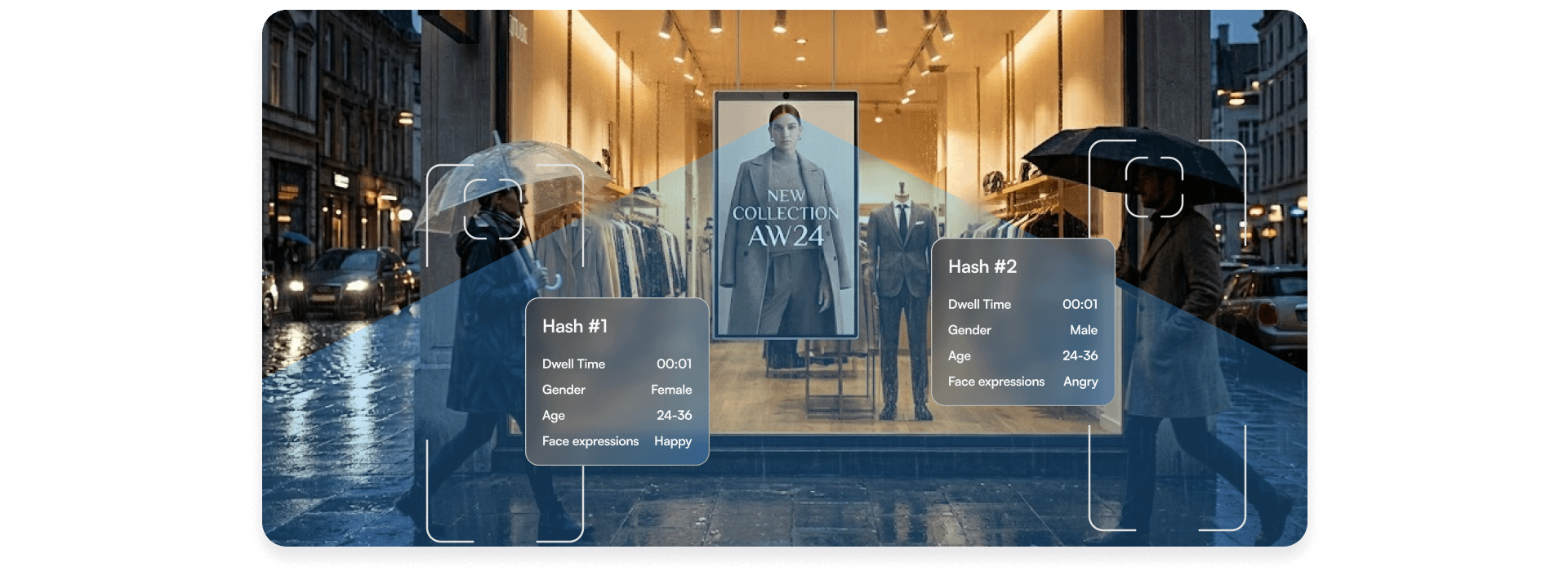

-

Understand Your Audience
Track foot traffic, demographics, and engagement to enable sharper targeting and deliver higher-impact campaigns.
-

Measure Ad Performance
Access real-world performance metrics to optimize content, refine strategy, and improve measurable results.
-

Keep Advertisers Confident
Share actionable insights that empower marketers and advertisers to prove impact and stay confident.
Receive Footfall Data on
the Number of People
Around Your Screens
Footfall measures how many people are present around a
screen during a specific period of time.
With AIScreen, this data is collected automatically so
marketers no longer have to rely on estimates or assumptions.
It helps teams understand the real audience size a screen is
reaching in different locations. By comparing footfall across
sites, advertisers can identify which placements deliver the
most exposure. This also makes it possible to calculate Cost
Per Person Reached (CPP) using actual audience data rather
than projections.


Analyze Audience Measurements by Hour
and Weekday
Audience presence is not consistent throughout the day or week, and this variation matters when planning campaigns. AIScreen breaks down audience data by hour and weekday to show clear traffic patterns over time.
This helps teams understand when screens attract the
most viewers and when traffic drops. With this
information, advertisers can schedule content during
peak periods instead of spreading messages evenly.
Better timing leads to more effective use of screen time
and higher visibility.
Analyze the Age and Gender Distribution of Your Audience
Audience analytics show the age ranges and gender distribution of people who appear in front of each screen. AIScreen processes this data anonymously to help advertisers understand who is actually being exposed to their content. Instead of guessing the audience profile based on location alone, teams can see real demographic patterns. These insights make it easier to adjust messaging so it aligns with the dominant audience at each screen. When content matches the audience more closely, engagement and campaign performance improve.


Sign in to AIScreen Free Digital
Signage Software
Sign in to AIScreen Free Digital Signage Software
Learn About Important Software Features for Digital Signage


Measure Conversion
Duration and Audience Engagement
Conversion duration measures how long a person stays meaningfully engaged with content on the screen. AIScreen uses camera-based detection within a defined viewing area to follow viewers over time instead of relying on single-frame detections.
Only viewers who remain in the region of interest and meet confidence and stability thresholds are counted, which filters out passersby and noise. The system then calculates how long each viewer stays present and attentive before leaving. This makes conversion duration a reliable indicator of real attention and overall content effectiveness, not just foot traffic.
Analyze Audience Dwell
and Attention Time in Physical Spaces
Dwell time shows how long a person stays near a screen, while attention time reflects how long they actively look at the content. AIScreen combines these signals to help brands understand not just presence, but actual interest.
This distinction is important because being nearby does not always mean paying attention. By analyzing dwell and attention together, teams can see which playlists or creatives hold interest longer. These insights help improve content decisions based on real behavior.


Enable Real-Time
Content Triggering Based
on Live Audience Data
Real-time content triggering changes what appears on the screen based on who is currently in front of it. With AIScreen, live age range and gender insights are used to adapt messaging automatically.
For example, if the audience shifts from younger viewers to older adults, the content can switch to something more relevant for that group. The same logic applies when audience composition changes throughout the day. This keeps messaging aligned with the people actually viewing the screen.
Get in Touch With Us for Expert Advice
Get in Touch With Us for Expert Advice
Improve Campaign Performance with A/B
Testing Insights
A/B testing compares different versions of content such as visuals, messages, layouts, and calls to action. AIScreen shows these variations at different times, locations, and audience conditions to observe real reactions.
The system measures attention, engagement duration, and viewing behavior instead of relying on clicks or assumptions. By comparing how audiences respond, it becomes clear which version performs better and why. These insights allow campaigns to be optimized using real-world audience behavior.


Ensure Continuous Measurement and Stability with Offline Playback
Offline Playback ensures that screens continue operating even when internet connectivity is interrupted. Detection of presence, attention, and dwell time continues locally because processing runs directly on the device. AIScreen uses edge AI architecture so both content playback and measurement logic remain active without cloud dependency. This prevents data gaps, content disruption, or trigger failures during network outages. Offline Playback guarantees consistent screen performance and uninterrupted attendance and attention tracking in any environment.
AI Settings for
Audience Analytics
AI Settings define how detection, triggering, and
analytics behave in real environments. Instead of treating
every location the same, these controls allow the system
to adapt to lighting conditions, crowd density, viewing
distance, and content strategy.


Frequently Asked Questions
AIScreen audience analytics helps you understand how people interact with your digital signage in physical spaces. It gives you measurable insights about viewer presence and behavior around each screen. Instead of relying on assumptions, you see data that supports smarter content decisions. AIScreen audience analytics turns screen activity into actionable performance insights.
AIScreen audience analytics helps advertisers transform digital signage from simple screens into intelligent marketing tools, providing real-time data to optimize campaigns and improve return on investment (ROI).
Yes, AIScreen provides audience analytics tools that directly support improved real-time targeting and increase the effectiveness of advertising campaigns.
Audience analytics reveal when adjustments are needed, whether through repositioning screens or refreshing visuals. These actionable insights improve enhancing engagement and support smarter content strategy decisions.
Yes, AIScreen audience analytics can automatically launch content in real time based on viewer demographics and behavior. This functionality transforms ordinary screens into “smart” displays that tailor messages to the individual in front of them.