
What Are the ADA Parking Space Signage Requirements?
Creating fully compliant ADA parking space signage is not just a legal obligation, it’s a crucial step toward ensuring accessibility, inclusivity, and safe navigation for individuals with disabilities. All you need to know about ADA parking space signage requirements begins with understanding how the Americans with Disabilities Act (ADA) enforces highly specific ADA parking requirements covering the number of accessible spaces, sign height, placement, image visibility, and maintenance standards. According to the U.S. Department of Transportation (DOT, 2022), approximately 25.5 million Americans have travel-limiting disabilities, making properly marked accessible parking and clear handicap parking sign visibility essential to help wheelchair users and individuals with limited mobility safely access public accommodations, businesses, and parking facilities.
In this blog, you will learn how to determine the required number of accessible parking spaces, understand exact ADA parking signage dimensions, and apply practical layout, marking, and visibility requirements. We’ll also cover space requirements for accessible entrances, proper use of the International Symbol of Accessibility (ISA), and the minimum height for fully compliant signage, concluding with insights into how modern digital signage solutions can support accessibility, improve ADA compliance, and prevent legal challenges related to improper parking space management.
By maintaining consistent sign height, visibility, symbol accuracy, and ADA compliance, property owners reduce legal risks under the disabilities act, ensuring access for wheelchair users and other individuals using mobility support devices. Many facilities now pair fixed signs with digital signage software to keep visibility, symbol accuracy, and compliance status under continuous review. Proper placement, visual clarity, and adherence to sign requirements contribute significantly toward preventing navigation challenges and maintaining long-term accessibility standards.
How Many ADA Parking Spaces Are Required?
Under ADA parking requirements, the minimum number of accessible vehicle parking stalls depends on the total number of parking spaces provided in the parking lot or parking structure.
Typically, for every 1 to 25 total spaces, at least one accessible space must be provided, and at least one of such spaces must be a van accessible parking space. Also, the ADA regulations specify that two accessible parking spaces may share one access aisle if sized correctly to ensure an unobstructed accessible route.
A recent study by the Centers for Disease Control and Prevention (CDC, 2023) indicates that 12.1% of U.S. adults rely on mobility aids such as wheelchairs and walkers, reinforcing the need for correct allocation of accessible spaces, clear signage, and direct access to entrance doors and accessible entrances to ensure compliance.
| Total Parking Spaces | Standard Accessible | Van-Accessible* | Total (Standard + Van) |
| 1–25 | 0 | 1 | 1 |
| 26–50 | 1 | 1 | 2 |
| 51–75 | 2 | 1 | 3 |
| 76–100 | 3 | 1 | 4 |
| 101–150 | 4 | 1 | 5 |
| 151–200 | 5 | 1 | 6 |
| 201–300 | 5 | 2 | 7 |
| 301–400 | 6 | 2 | 8 |
| 401–500 | 7 | 2 | 9 |
| 500–1000 | 5 out of every 6 spaces | 1 out of every 6 | 2% of total parking provided |
| 1001+ | 5 out of every 6 spaces | 1 out of every 6 | 20 + 1 for each 100 over 1000 |
Required ratios under ADA standards include:
- 1 accessible space per 25 parking spaces up to 100 total spaces.
- 2 accessible parking spaces for 51–75 parking spaces.
- 1 van accessible space per every 6 accessible spaces.
- For outpatient physical therapy facilities or rehabilitation facilities, 20% of parking spots must be accessible parking spaces due to high mobility impact.
- At least one accessible parking space must be van accessible with an access aisle located on the passenger side.
Ensuring compliance with ADA parking compliance, building codes, property owners’ obligations, and local governments’ enforcement helps avoid legal action and supports accessibility for wheelchair users, delivery vehicles, law enforcement vehicles, and other public spaces.
What Are ADA Parking Signage Requirements?
To meet full ADA parking space requirements for accessible signage, all spaces must be clearly marked using a separate sign featuring the International Symbol of Accessibility. This universally recognized wheelchair symbol, displayed in white against a blue background, helps ensure that accessible parking locations are easily identified from a moving vehicle.
According to ADA regulations, the sign requirements state that the bottom edge of the handicap parking sign must be positioned at least 60 inches (5 feet) from the parking surface, preventing obstruction even when other parking spaces or vehicles are present nearby.
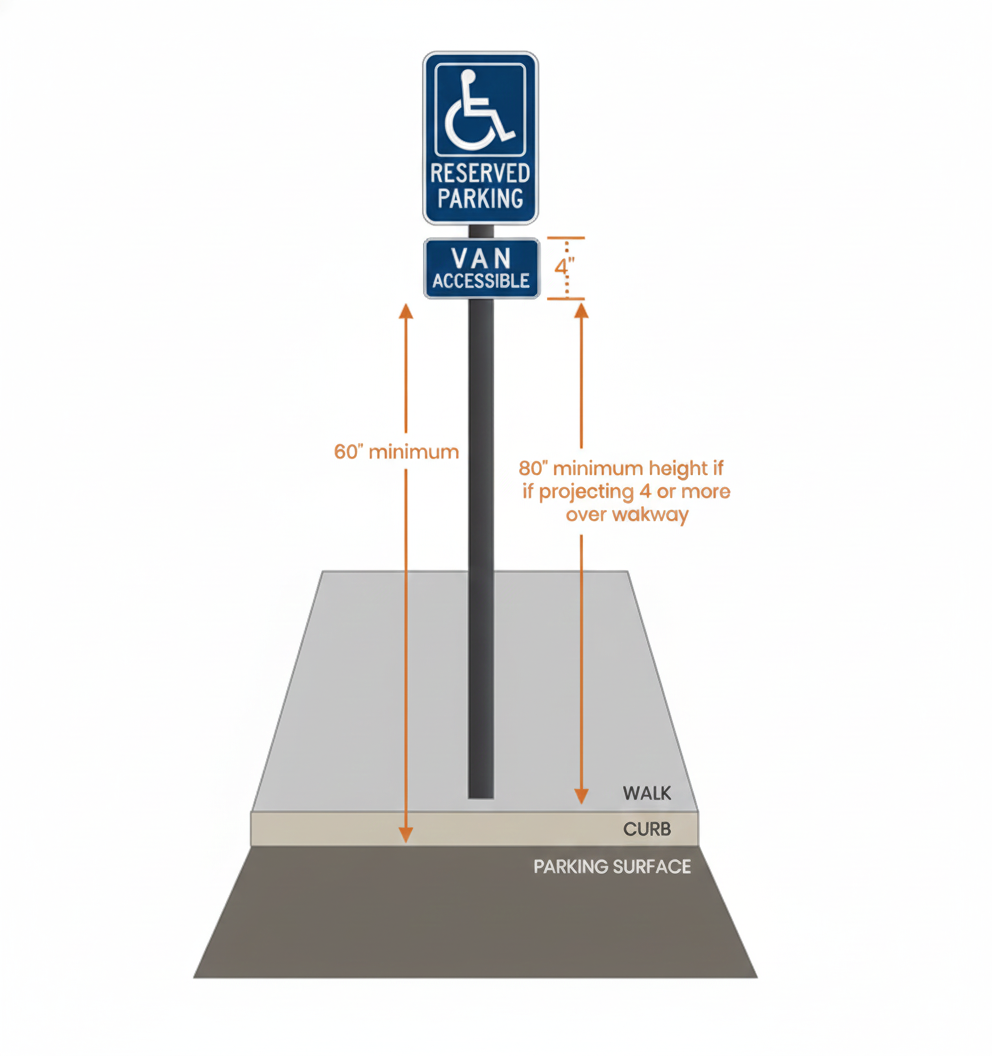
The signage post should be installed at the head of the parking space, ensuring that vehicles entering or exiting the parking facility are not restricted. It must remain clearly visible from the driver’s side, particularly when navigating parking lots, visitor parking, or restricted parking areas.
If the stall is designated as a van accessible parking space, the sign must include corresponding text placed just below the accessibility symbol, clearly indicating van accessibility. This is critical in locations with van parking spaces, medical facilities, or high-traffic parking structures, where spaces must meet minimum requirements and enable smooth deployment of lifts and mobility aids.
By maintaining consistent sign height, visibility, symbol accuracy, and ADA compliance, property owners reduce legal risks under the disabilities act, ensuring access for wheelchair users and other individuals using mobility support devices. Proper placement, visual clarity, and adherence to sign requirements contribute significantly toward preventing navigation challenges and maintaining long-term accessibility standards.
Where Should ADA Parking Spaces Be Located?
Under ADA parking space requirements, the designated accessible parking spaces must be located along the shortest accessible route connected to building entry and exit points. Placement should prioritize access to accessible entrances, ramps, and pathways free from curbs or barriers.
This ensures that individuals with disabilities can safely reach entrance doors directly from the parking lot, without navigating obstacles that could violate ADA compliance or building accessibility policies.
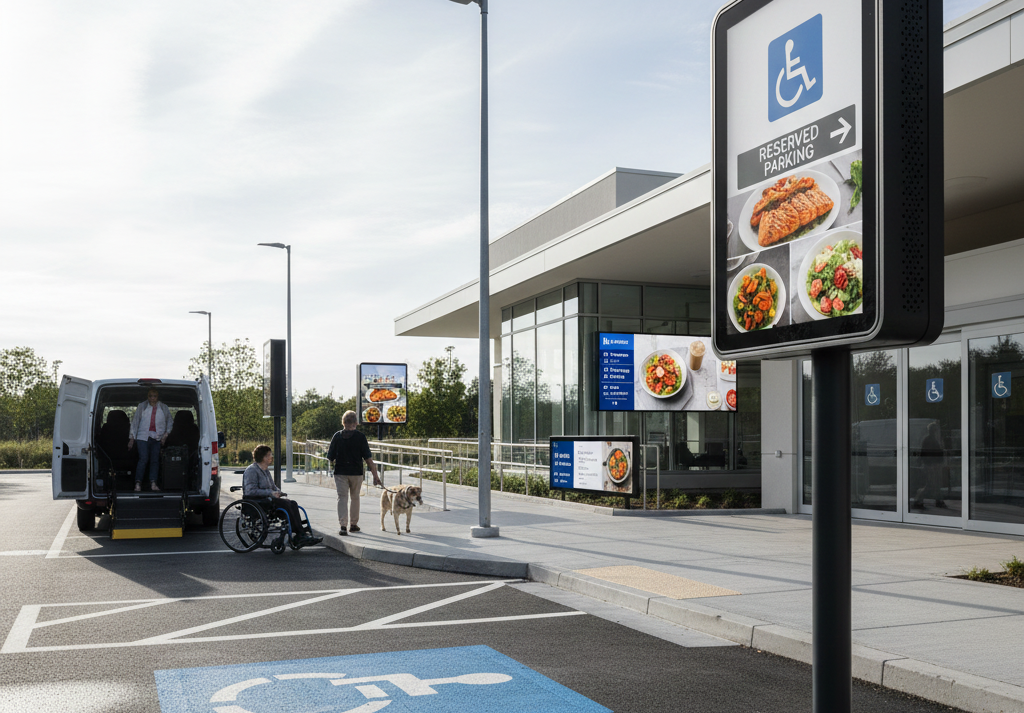
The location of each handicap parking sign should correspond with visible, strategically positioned spaces to guarantee right-of-way for handicap accessible parking spaces. Correct site planning allows users to exit vehicles without interference, particularly in parking structures, parking facility transfer zones, or areas servicing multiple buildings.
In addition, positioning near ramps and immediate entryways assists users with wheelchairs, walkers, or other mobility aids in aligning their path with the accessible route, ensuring they reach the entry with minimal travel effort.
Barriers that obstruct entry, such as landscaping edges or poorly aligned curbs, should be modified or removed. Failure to comply with this layout requirement may negatively affect accessibility ratings and create risk for legal action under the disabilities act.
Ensuring optimal space placement also considers high-demand zones such as visitor parking and parking lots at medical centers, where accessible spaces required are generally higher to support patient needs. Correct distance allocation protects compliance with minimum requirements while prioritizing accessibility over parking convenience for other spaces.


What Size Are ADA Parking Spaces?
The ADA outlines detailed specifications for handicapped parking layout and pavement marking to guarantee compatibility with assistive loading devices and safe maneuvering. Accessible Parking Space Dimensions and Pavement Marking Specifications define that each accessible parking space should be at least 96 inches (8 feet) wide and extend to the full length of the designated parking space.
An adjacent access aisle, with a minimum width of 60 inches (5 feet), must be provided to accommodate equipment deployment and user movement. Under ADA regulations, one access aisle may serve two spaces, provided that accessibility is not compromised.
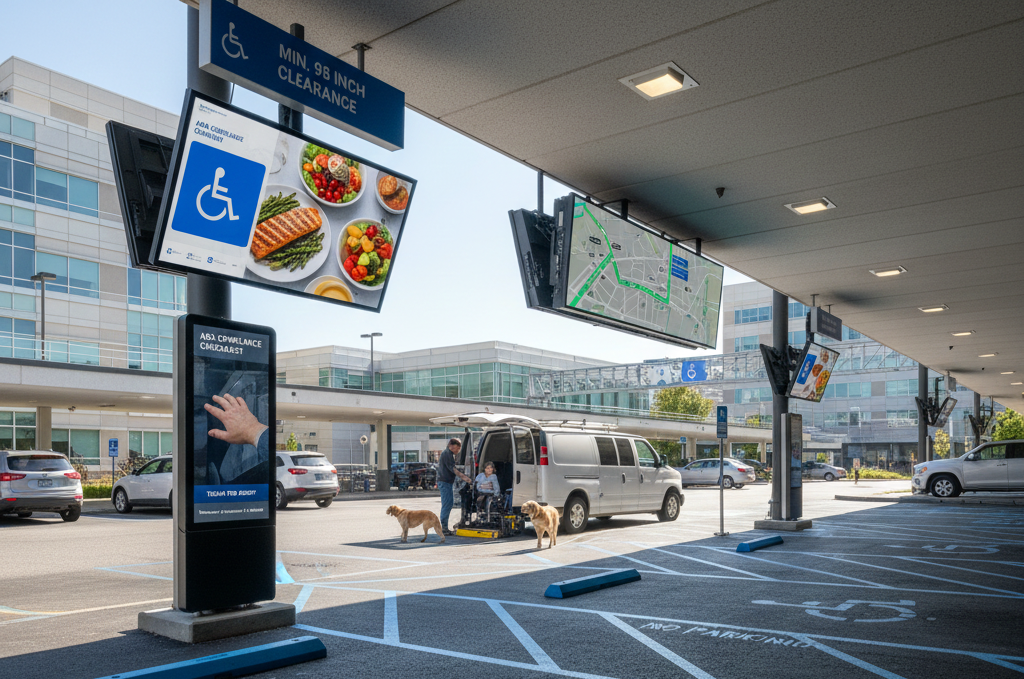
For van accessible parking spaces, the required width increases to 132 inches (11 feet), or alternatively remains at 96 inches (8 feet) where the adjacent access aisle is widened to 96 inches. This aisle must be located on the passenger side, as mobility devices such as wheelchair lifts are typically deployed from this area. A vertical clearance of at least 98 inches (8.17 feet) must be maintained for both van-accessible stalls and the surrounding vehicular route to allow adequate lift operation height.
Markings should meet visibility and contrast standards by using blue for the background and white for the international symbol, although other high-contrast colors such as yellow, red, or green may be permitted under relevant local building codes. Diagonal hatch markings should be applied throughout the access aisle to discourage parking and improve safety.
Adding “No Parking” pavement text can further support compliance. Applying highly visible paint helps ensure accessible parking spaces remain distinguishable in various lighting conditions and promotes consistent alignment with ADA compliance requirements in all parking facilities, parking structures, and public spaces.
Each of these details contributes to maintaining the required parking ratios, protecting van accessibility, and meeting inspection standards. Ensuring contrast clarity, clear route alignment through an accessible route, and adherence to minimum number requirements for accessible parking spaces helps preserve accessibility for public accommodations, medical environments, employee facilities, and high-traffic transportation areas.
What Does ADA Parking Painting Cost?
When determining how much to charge for ADA-compliant handicap painting, pricing typically varies based on region, material quality, surface condition, and project complexity. Industry averages suggest that costs can range between $150 to $400 per handicap parking spot, including striping, the international symbol of accessibility, access aisle marking, and any required repainting.
The estimate may increase for larger parking lots or surface repairs, especially when dealing with cracks or uneven areas. Projects involving high-durability paint, thermoplastic application, or reflective coatings generally fall on the higher end due to longer-lasting compliance support.
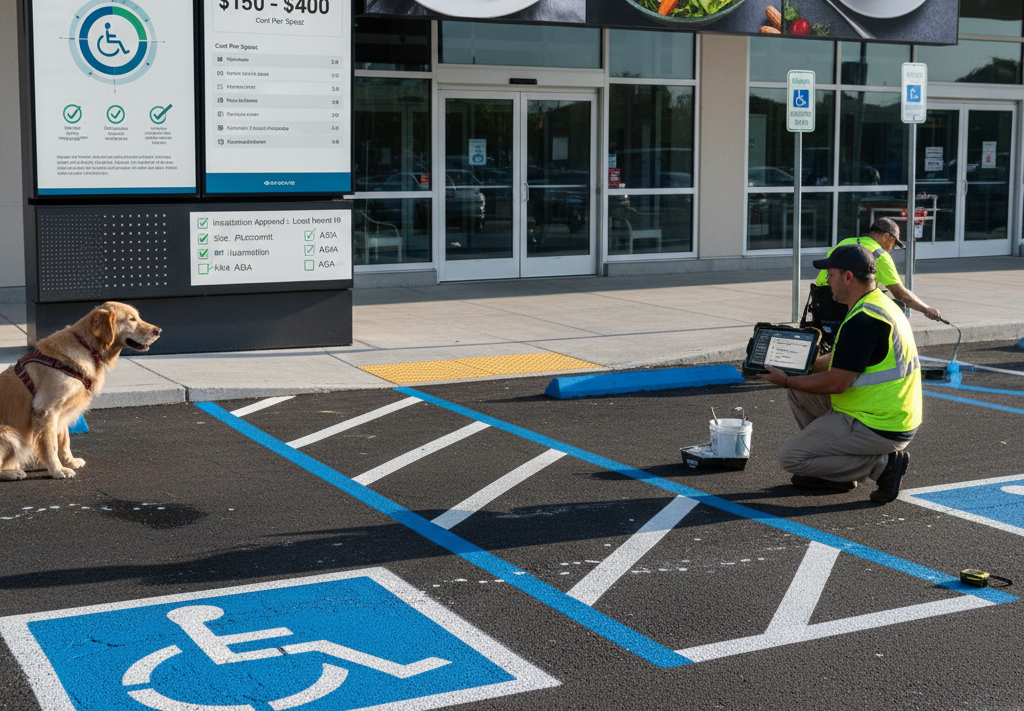
Ensuring long-term visibility for vehicle parking spaces is critical to maintaining compliance under ADA standards. Fresh, non-faded paint improves visibility, enhances safety, and reduces liability risks for property owners. According to a 2023 report by the U.S. Access Board, over 35% of ADA-related parking non-compliance issues stem from inadequate pavement markings or faded signage, making regular repainting and inspection a vital preventable expense (U.S. Access Board, 2023).
Contractors should also consider additional charges if installation involves van accessible spaces with extended access aisles or where layouts need surface corrections to meet parking space design adjustments. Always perform a pre-project inspection to assess whether new markings can be applied directly or if resurfacing is required to restore contrast and durability.
How to Maintain ADA Parking Signs?
Maintenance guidelines include regular inspection, cleaning, and repainting, which are essential to ensure ongoing compliance and visibility of handicap parking spot markings. ADA standards require that accessible parking spaces, parking spots, through-ways, access aisles, and accessible route pathways remain free from obstruction and deterioration.
Worn or faded paint can lead to failed compliance inspections or local enforcement fines, especially if the international symbol of accessibility (ISA) is unclear or if directional guidance toward the shortest accessible route is compromised.
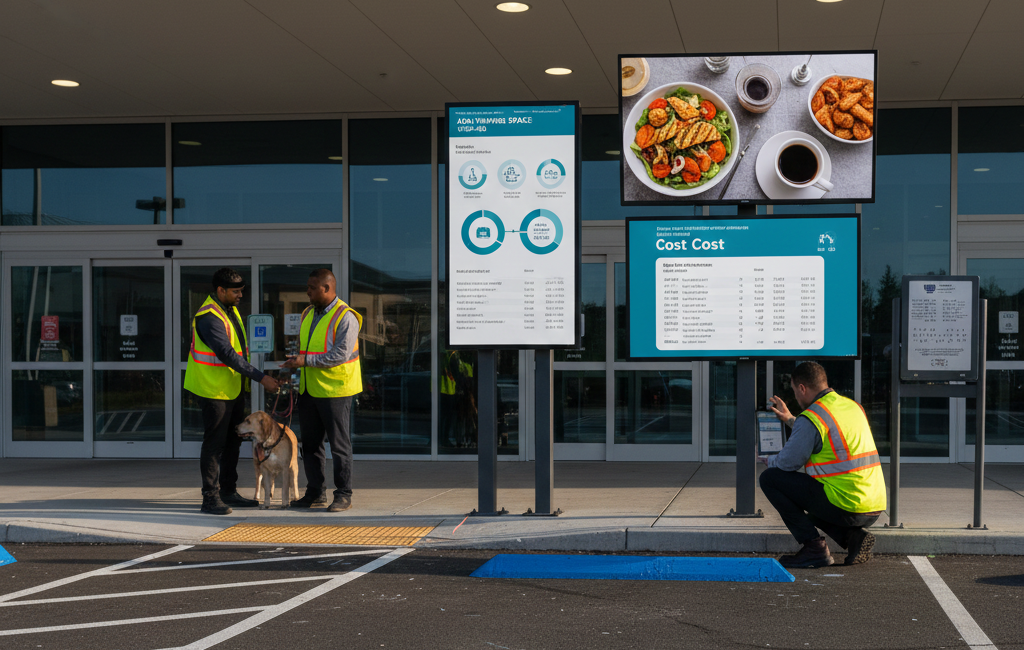
Maintenance best practices recommend scheduling annual compliance reviews and surface assessments to determine contrast quality and paint reflectivity. Accessible parking spaces must be kept free from loose gravel, trash, fallen leaves, debris, mud, ice, or potholes. Damaged surfaces should be repaired immediately to restore proper slope, minimum width, vertical clearance, and durable signage visibility. Van accessible spaces and vehicular route markings require additional care due to higher maneuvering activity.
Parking lots with a higher number of accessible parking areas should incorporate a structured maintenance calendar. As outlined in professional pavement care guidance, “accessible parking spaces, their corresponding access aisles, through-ways and routes should always be kept clean and in good condition.
Cracks and potholes should be repaired immediately…” Regular care ensures that each accessible space remains clearly marked and that signs meet height and placement standards, even in high-traffic or weather-exposed zones, an approach that aligns well with 37 creative signage design to inspire thoughtful, long-lasting accessibility solutions.
Which Laws Govern ADA Parking Signs?
The primary legal references governing ada parking space requirements include the ADA Standards for Accessible Design (2010) and enforcement under the Department of Justice (DOJ) guidelines.
These regulate spacing, layout specifications, van parking spaces, fraction thereof calculations for the minimum number of accessible parking spaces required, and signage placement, including clearance of the bottom edge, vertical clearance, and direction of vehicular route signage.
However, beyond these federal standards, many states and municipalities enforce additional regulations such as bilingual sign requirements, enhanced reflective coatings, night visibility treatments, or digital monitoring triggers to support ADA compliance. Regional enforcement may include requirements for supplemental symbols, access aisle dimensions, or minimum vertical clearance for van accessible parking space categories.
According to a study conducted in 2022 by Harvard T.H. Chan School of Public Health, approximately 28% of U.S. commercial facilities failed initial ADA parking inspections due to improper signage placement or missing ISA markings, emphasizing the importance of verifying state or city-level accessibility standards before application (Harvard T.H. Chan School of Public Health, 2022).
Failure to comply can result in penalties ranging from $1,500 to more than $10,000, depending on jurisdiction, scope of violation, and the number of outstanding deficiencies. Therefore, before striping a parking facility, always check accessible parking space regulations locally to avoid costly corrective action.
Can Digital Signage Improve ADA Parking?
As the digital signage market grows, digital signage plays an increasingly vital role in improving parking accessibility across every parking facility.
Modern handicapped parking sign solutions use real-time directional guidance, digital wayfinding systems, and occupancy indicators to help visitors quickly locate accessible parking spots and van accessible areas.
Integrating digital signage with smart sensors, EV charging systems, and ADA navigation apps enables instant communication when a parking space becomes available, blocked, or requires maintenance.
These systems help property owners track compliance performance, monitor signage visibility, and trigger repainting or review alerts when sign reflectivity drops below acceptable thresholds. Digital updates are especially useful in large or multi-level parking lots, where communicating access aisle information and route navigation significantly improves visitor experience for individuals with disabilities.
What Else Does ADA Signage Cover?
Before finalizing parking layouts, it helps to step back and review what is ADA signage at a broader level, since accessible parking signs are only one category within a wider family of compliant wayfinding, restroom, entrance, and directional markers. Understanding how these standards connect gives property owners a clearer framework for consistent placement, contrast, and symbol accuracy across every accessible space, aisle, and route in a facility.
How Can AIScreen Support ADA Parking Space Signage?
Meeting ADA parking space signage requirements means providing the correct number of accessible spaces, placing signs at the proper height and location, using clear pavement markings, and maintaining visibility throughout the year. Getting these fundamentals right helps property owners improve accessibility, support visitors, and keep parking areas aligned with applicable requirements.
As a leading provider, AIScreen helps organizations strengthen accessibility communication with digital signage for directions, parking updates, accessibility notices, and real-time facility information. With centralized content management and remote updates, AIScreen can complement ADA parking space signage and help create a clearer, more accessible experience across properties.
Frequently Asked Questions
What are the ADA parking requirements?
The ADA parking requirements specify the minimum number of accessible parking spaces based on total parking spaces provided, ensuring that every facility includes designated accessible parking spaces, van accessible spaces, and clearly marked access aisles. These standards ensure safe entry, clear vehicular route guidance, and appropriate surface marking for long-term accessibility.
How does the ADA define signage requirements for accessible parking spaces?
The ADA defines signage requirements as visibility-compliant markings showing the international symbol of accessibility and specifying when a van accessible space applies. Signs must be mounted at the correct height and ensure the symbol of accessibility (ISA) remains visible from the driver’s viewpoint regardless of vehicle size or weather conditions.
Why are ADA-compliant parking signs important for accessibility and safety?
ADA-compliant parking signs are essential because they help clearly identify accessible spaces, guide users to the shortest accessible route, and ensure reserved access for individuals with reduced mobility. Properly displayed signs reduce confusion, improve navigation, and help prevent unauthorized parking.
Can one parking sign serve multiple accessible spaces under ADA rules?
Yes, but one parking sign can only serve multiple spaces if those two spaces directly align with a shared access aisle and both comply with ADA layout specifications. The signage must still clarify if a van space is included and ensure the orientation maintains full sign visibility for each allocated spot.
How often should ADA parking signage be reviewed or replaced for compliance?
ADA parking signage should be reviewed annually to confirm paint contrast, ISA clarity, and structural placement stability. Signs should be replaced immediately if faded, obstructed, damaged, or if property owners modify parking lots layouts, ensuring uninterrupted accessibility and regulatory compliance.
