
What is Impact of Digital Signage Illustration on Communication?

Incorporating illustrations into communication significantly boosts effectiveness by simplifying complex ideas, enhancing engagement, and improving information retention. Studies reveal that, presentations utilizing visual aids are found to be 43% more persuasive, underscoring the persuasive power of visuals, researched by AIScreen’s team.
In this blog post, we will explore various communication models, linear, interactive, and transactional, and examine how illustrations play a crucial role in enhancing each. You’ll learn how visual aids simplify complex information, facilitate better understanding, and foster more engaging interactions across different communication contexts.

Short Summary
- Illustrations simplify complex ideas, enhance engagement, and help retention by turning abstract concepts into tangible visuals.
- Key Communication Models include, linear, interactive, and transactional models, illustrating how visual aids enhance understanding in each model.
- Communication models with illustrations help identify potential issues, improve interactions, and prepare for future communication scenarios.
- Digital communication trends use visual tools to enhance engagement, while illustrations also clarify safety information, ensuring clear understanding.
How Do Illustrations Influence the Effectiveness of Communication?

Illustrations significantly enhance communication effectiveness by simplifying complex ideas, improving engagement, and aiding retention. Visuals help break down intricate information, making it easier for audiences to grasp key messages quickly.
They also create an emotional connection, making content more memorable and impactful. Illustrations turn abstract concepts into tangible visuals through clarity and creativity, boosting understanding and overall communication success.
What are Communication Models?

According to Denis McQuail in Mass Communication Theory, “a model is a simplified representation, either in words or diagrams, of part of the dynamic mass communication process.”
In simpler terms, communication models visually represent the different parts of a communication situation. Since communication can be complex, it’s often hard to figure out where a conversation starts and ends.
This is where communication models come in; they help make understanding communication easier.
Some models are more detailed, while others are simpler, but even the most detailed models can’t fully capture everything that happens during a conversation.
How Communication Models and Illustration Can Improve Work Communication

Effective communication is key in any organization. Communication models, especially with illustrations, help us:
- Think deliberately about communication
- Learn from past experiences
- Prepare for future interactions

Misunderstandings, like misinterpreted tone or emails lost in spam, are common. Communication models simplify these situations by visually representing key components, making identifying and preventing potential issues easier.
Illustrations enhance our understanding of communication processes, helping us improve workplace communication.
What Are the 8 Major Communication Models and How Do Illustrations Play a Role?

There are 8 major communication models divided into 3 categories, each serving to simplify and clarify different communication processes.
Linear Models of Communication
These models represent one-way communication. Key models include:
- Aristotle’s Communication Model
- Lasswell’s Communication Model
- The Shannon-Weaver Communication Model
- Berlo’s S-M-C-R Communication Model
Illustrations of these models show the flow of information in one direction, helping to understand each element involved.

Interactive Models of Communication
These models focus on two-way communication. Notable models include:
- The Osgood-Schramm Communication Model
- The Westley and Maclean Communication Model
Illustrations of these models demonstrate the exchange and feedback between the sender and receiver, clarifying the process.

Transactional Models of Communication
These models highlight complex, evolving two-way communication. Important models are:
- Barnlund’s Transactional Communication Model
- Dance’s Helical Communication Model
Illustrations help depict messages’ continuous and dynamic exchange, showing how both parties influence communication.

Illustrations make these models more straightforward, clearly representing the communication process in different scenarios.
What Are Linear Communication Models and How Do Illustrations Help?

Linear communication models are used primarily in marketing, sales, and PR, where communication flows in one direction.
These models focus on key elements such as the sender, message, channel, and receiver, with noise acting as any interference.
Illustration helps visualize how the message flows from sender to receiver, making it easier to understand the process.
1. Aristotle’s Model of Communication

Aristotle’s model, dating back to 300 BC, focuses on a one-way flow from the speaker to the audience. It emphasizes the importance of ethos (credibility), pathos (emotional appeal), and logos (logic). Illustrations help clarify how these elements work together in public speaking and presentations.
2. Lasswell’s Model of Communication

Lasswell’s model answers five questions: Who, What, Channel, To Whom, and What Effect. Illustrations of this model show how each component, communicator, message, medium, audience, and effect, connects in the communication process.
3. Shannon-Weaver Model of Communication

The Shannon-Weaver model is a popular linear model that adds noise to communication. Illustrations of this model help visualize the flow from sender to receiver with the potential interference of noise, like misunderstandings or technical problems.
4. Berlo’s S-M-C-R Model of Communication

Berlo’s model identifies four key elements: Source, Message, Channel, and Receiver. Illustrations of the S-M-C-R model show how the sender’s skills, knowledge, and attitude influence the message sent and how the receiver interprets it.
These models use illustration to simplify understanding the communication process by visually representing the key components, showing how messages are transmitted, received, and sometimes distorted.
These visual models make complex communication processes more accessible, helping us improve interactions in various contexts.
What Are Interactive Communication Models and How Do Illustrations Help?
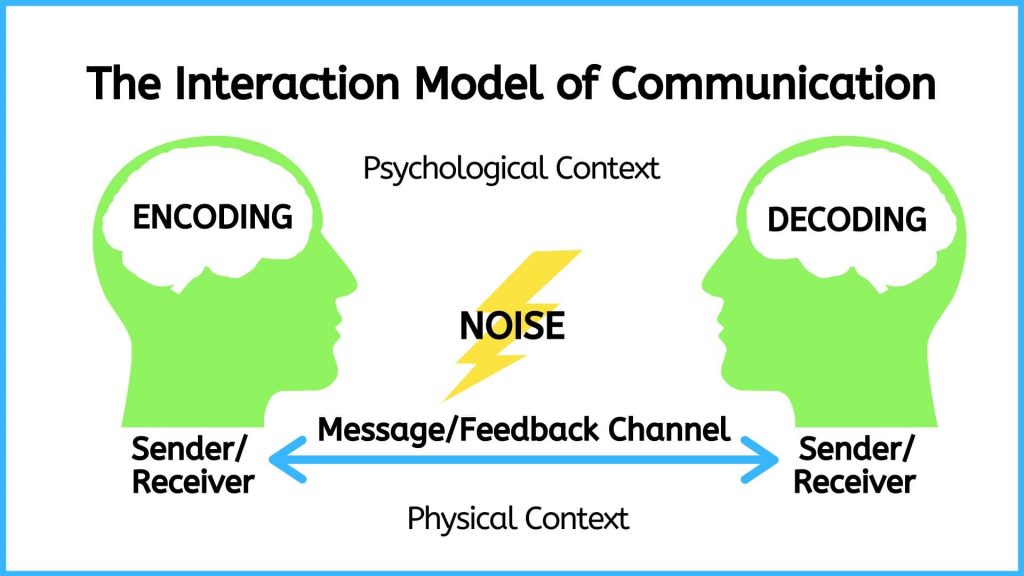
Interactive communication models focus on two-way communication with feedback. Unlike transactional models, feedback is not immediate; it’s slow and indirect. These models are helpful in situations like phone calls and letters.
Key Elements of Interactive Communication Models

The main components of interactive models include:
- Sender
- Message
- Receiver
- Feedback
- Field of Experience
The Field of Experience represents each person’s unique background, culture, and past experiences, influencing how both the sender creates the message and the receiver interprets it. Illustrations of these elements help visualize how these factors influence communication.
The Osgood-Schramm Model of Communication

This circular communication model emphasizes that the sender and receiver play equal roles in encoding and decoding messages.
Communication is dynamic and continuous, with no clear beginning or end. Illustrations of this model help show the back-and-forth nature of the process, where both parties constantly interpret and respond to each other.
The Westley and Maclean Model of Communication

This model focuses on the environmental factors that influence communication, like the culture and background of the sender and receiver.
The communication process starts with an environmental stimulus (such as witnessing an event), leading the sender to create and transmit a message.
Feedback is essential to this model, making it circular rather than linear. Illustrations of this model show how external factors and feedback loops shape communication.

These interactive models become easier to understand by using illustrations. They show how communication is influenced by feedback and personal experiences, improving our understanding of interpersonal and mediated communication.
What Are Transactional Communication Models and How Do Illustrations Help?

Transactional communication models view communication as a dynamic process where both the sender and receiver are active participants.
Unlike linear models, transactional models recognize communication as a two-way, cooperative exchange. The key idea is that both communicators co-create meaning and influence the outcome of the interaction.
Key Elements of Transactional Communication Models

The main elements include:
- Encoding
- Decoding
- Communicators
- Message
- Channel
- Noise
Illustrations of these elements help visualize how communication is an ongoing exchange, influenced by feedback, context, and noise.
Barnlund’s Transactional Model of Communication

Barnlund’s model shows communication as a circular process with immediate feedback between sender and receiver. Both parties influence the message and respond to cues (public, private, and behavioral). Feedback helps improve communication and resolve misunderstandings.
Example:
A business conversation might be misunderstood due to cultural differences. If both parties had clarified their intentions, feedback would have helped avoid confusion. Illustrations of this model highlight how cues and feedback shape communication.
Dance’s Helical Model of Communication

Dance’s Helical model represents communication as a continuous, expanding spiral. With each exchange, the process becomes more complex. Communication never repeats, and feedback from each interaction improves future exchanges.
Example:
A person learning to communicate evolves, starting with essential communication and gradually improving through feedback. Illustrations of this model help demonstrate how each interaction builds on the previous one, making communication more effective over time.

Using illustrations in transactional models makes the complex nature of communication more explicit, showing how both senders and receivers are involved in shaping the message and influencing the outcome.
What Are the Trends in Communication and the Role of Illustrations?

Digital communication is a key trend as communication evolves. It incorporates visuals like infographics, video calls, and social media platforms to enhance engagement. Tools like digital signage are also adapting fast, especially when exploring what are the top trends in digital signage communication for smarter business strategies in 2025? — as organizations seek more effective ways to connect and communicate
Communication illustrations help simplify complex ideas, making interactions more dynamic and accessible. Organizations embracing these trends can target audience improve connection and effectively meet modern communication needs.
How Does Safety in Communication Benefit from Communication Illustrations?

Safety in communication has become vital, particularly in digital spaces. Illustrations help clarify important information such as privacy policies and security protocols, ensuring that complex safety concepts are understood easily.

AIScreen enhances digital communication by incorporating visuals into real-time interactions, making it easier to convey safety measures, updates, and alerts effectively.
Communication illustrations make it easier to communicate sensitive data clearly, fostering respect and protecting everyone involved in the communication process.

FAQs
How do illustrations improve communication?
Illustrations enhance communication by simplifying complex ideas, engaging audiences, and creating an emotional connection that supports better understanding and retention of information.
Can illustrations replace written communication entirely?
While illustrations complement written content greatly, they can’t replace all forms of communication. They are best used to simplify, emphasize, or clarify key points.
What types of illustrations are best for digital communication?
Infographics, icons, animated designs, and illustrations in app interfaces are all highly effective in digital communication, making content more engaging and user-friendly.
How Can Illustrations Enhance Communication?


In conclusion, illustrations play a crucial role in enhancing communication by simplifying complex ideas, fostering emotional connections, and improving audience engagement.
Whether it’s through linear, interactive, or transactional communication models, illustrations make it easier for individuals and organizations to convey their messages clearly and effectively.
AIScreen, a leading provider in digital signage solutions, understands the power of visual communication and continues to use illustrations to enhance message delivery, making interactions more dynamic and impactful. Contact us for more details.
