
What is Digital Signage Safety Sign and Symbol? A Simple Guide

Safety signs and symbols are essential for protecting people and preventing accidents in workplaces and public spaces.
According to the Occupational Safety and Health Administration (OSHA), proper use of safety signs can reduce workplace accidents by up to 50%, researched by the AIScreen team.
This guide will help you understand the different types of safety signs, their meanings, and how to use them effectively to create a safer environment.
You’ll learn about various sign categories, such as warning signs, fire safety signs, hazardous materials signs, and tips for correctly displaying safety signs and symbols.
You will be better equipped to recognize and implement safety measures that reduce risks and keep everyone safe.

Short Summary
- Safety signs and symbols are vital in preventing accidents and injuries, and safety messages must be communicated.
- Digital signage solutions provide customizable templates for effective safety signage management.
- Safety signs include warning, prohibition, mandatory, emergency, fire safety, and hazardous materials, each serving a unique purpose.
- GHS pictograms label hazardous chemicals, help workers understand risks, and prevent exposure.
What are Safety Signs and Symbols?

Safety signs and symbols are easy-to-recognize graphic labels. They show safety instructions and rules in workplaces, public places, and other locations.
These signs may look different in different countries, but their primary purpose is the same: to share safety employee communication information in a way that is easy for everyone to understand.
Why are Safety Signs Important?
- They help prevent injuries and accidents.
- They warn about dangers, hazards, or risks in certain places or with particular items.
These signs make safety information clear for everyone, regardless of their language.
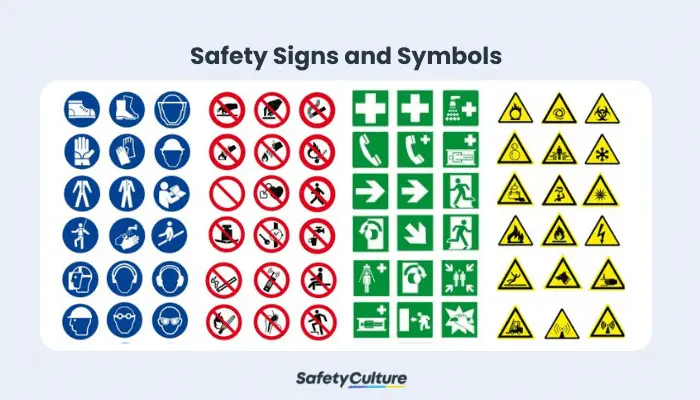
Why Use Safety Symbols
ISO Standard (ISO 3864-1:2011) says safety signs should use fewer words to make understanding easier.
Purpose of Safety Signs:
- They communicate safety messages, warnings, and instructions.
- They help people understand information quickly.
- They are helpful in emergencies when fast action is needed.
How They Help:
- Reduce accidents by warning about dangers.
- Increase awareness of hazards in specific places or materials.
- Use visual symbols so everyone can understand, no matter their language.

How to Set Up Safety Signs Effectively
Here’s how to effectively create safety signs using AIScreen’s digital signage platform:
1. Choose the Best Solution
Select a digital workplace safety signage platform that offers user-friendly design tools, customizable templates, and the ability to integrate with existing systems.
AIScreen provides a comprehensive solution with over 100 free, built-in app integrations, allowing you to seamlessly incorporate content from tools like Microsoft Suite, Excel, and Google Suite.
2. Install the Software
Download and install the AIScreen software on your devices. The software offers a 14-day free trial with no credit card required, allowing you to explore its features and determine whether it meets your needs before committing.

3. Utilize Pre-Designed Templates
AIScreen provides a variety of customizable templates designed specifically for safety signage. These templates meet industry standards and can be easily modified to suit your requirements. Choose a template that aligns with your safety needs and customize it as required.
4. Customize Content
With AIScreen’s intuitive interface, you can easily add or edit text, upload images, and adjust layouts to create safety signs that communicate the required messages. This customization ensures the signs are informative and aligned with your workplace’s safety protocols.
5. Plan and Display Signs
After designing your safety signs, use AIScreen’s scheduling feature to display them at the correct times. This feature ensures that the safety information is visible when needed, improving awareness and reducing the risk of accidents.
6. Monitor and Update Remotely
AIScreen provides the ability to manage and update your safety signs remotely. This means you can ensure that your signage remains up-to-date and effective without manual updates, saving time and ensuring consistent communication.
Types of Safety Signs and Symbols
Safety sanitize hands signs come in different colors, shapes, and meanings. Some may include words, while others rely only on symbols.
Employees need to understand these signs to prevent accidents.
This section will explore 7 types of safety signs, their meanings, and examples.
1. Warning Safety Signs

These signs warn about dangers that could cause injury or death.
They are usually triangle-shaped with a black border and a yellow background.
Examples:
- Danger: High Voltage
- Caution: Slippery Floor
- Warning: Radiation Area
- Beware: Falling Objects
Always pay attention to these signs to stay safe.
2. Prohibition Safety Signs

These signs show actions that are not allowed.
They are usually circle-shaped with a red border and a white background.
Examples:
- No Smoking
- Do Not Enter
- No Photography
Follow these signs to avoid breaking the rules or causing harm.
3. Mandatory Safety Signs

These signs show actions you must follow for safety.
They are usually circle-shaped with a blue background and white symbols or text.
Examples:
- Wear Safety Glasses
- Use Handrail
- Hard Hat Area
Always follow these signs to stay safe.
4. Emergency Safety Signs

These signs show where to find emergency equipment or help.
They are usually rectangular-shaped with a white background and green text or symbols.
Examples:
- Emergency Exit
- Fire Alarm
- First Aid Station
Look for these signs in case of an emergency.
5. Informational Safety Signs

These signs give essential safety and health information to people in the area.
They are usually rectangular-shaped with a white background and black text or symbols.
Examples:
- Authorized Personnel Only
- No Parking
- Caution: Hearing Protection Required
Pay attention to these signs to stay informed and safe.
6. Fire Safety Signs

These signs provide information about fire safety, like where to find fire extinguishers, fire hoses, and fire alarms.
They are usually rectangular-shaped with a red background and white text or symbols.
Examples:
- Fire Exit
- Fire Hose
- Fire Alarm Pull Station
Look for these signs to stay prepared in case of a fire.
7. Hazardous Materials Safety Signs

These signs provide information about hazardous materials and the safety precautions you should follow.
They are usually diamond-shaped with a white background and red or yellow text or symbols.
Examples:
- Flammable
- Radioactive
- Corrosive
Pay attention to these signs to avoid danger when handling hazardous materials.
Benefits of Safety Signs

- Reduces workplace accidents: Safety signs help prevent accidents by alerting workers to potential hazards, leading to fewer injuries and incidents.
- Increases awareness and compliance: Clear signs make workers more aware of safety protocols and encourage them to follow safety regulations and rules.
- Safety signs contribute to a safer working environment by identifying risks and guiding employees to avoid them.
- Enhances communication of critical safety information: Signs provide clear, easy-to-understand messages about risks and precautions, improving overall safety communication.
What are GHS Pictograms?

GHS pictograms are graphic labels that show the potential risks of a specific chemical and the dangers of being exposed to it without protection. These labels have:
- A symbol on a white background
- Red borders around the symbol
- An image that represents the type of hazard
These pictograms are part of the Globally Harmonized System (GHS) for labeling and classifying chemicals, an internationally agreed-upon standard for identifying hazardous chemicals.
According to the Occupational Safety & Health Administration (OSHA) and the updated Hazard Communication Standard (HCS), all chemical labels must include:
- A standardized signal word
- A precautionary statement
- The relevant pictogram for each hazard class and category.
GHS Pictograms: Hazards and Classification
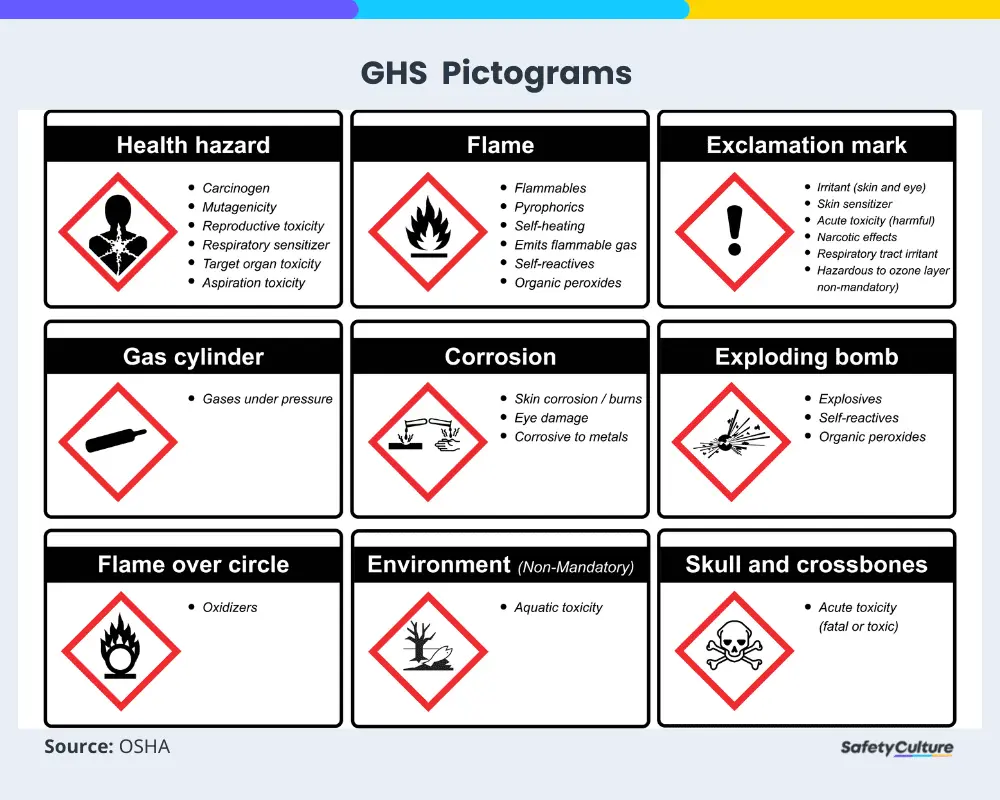
GHS Pictograms and Their Hazards
GHS pictograms are used to show the risks of chemicals. They are grouped based on whether the hazard affects health, the environment, or physical safety. Here are the types of GHS pictograms and what they mean:
- Health Hazard: A symbol of a person with damage, showing chemicals that can cause serious and long-term health problems.
- Flammable: A flame symbol showing chemicals or gases that can easily catch fire when exposed to air or heat.
- Irritant/Hazardous to Ozone Layer: A big exclamation point indicating chemicals that can irritate the skin or eyes, harm people, or damage the ozone layer.
- Gas Under Pressure: A gas cylinder symbol showing gases stored under pressure that can explode if heated or cause burns if refrigerated.
- Corrosion: A symbol of damaged material and skin, showing chemicals that can burn skin or damage tissue.
- Explosives: An exploding bomb symbol showing chemicals that can explode or cause large-scale explosions.
- Oxidizers: A flame over a circle symbol, indicating chemicals that can cause fires or explosions when mixed with other substances.
- Hazardous to the Environment: A dead tree and fish symbolize chemicals that can harm the environment.
- Toxic: The skull and crossbones symbolize chemicals that can cause severe health damage or even death, even with small exposure.

How Do Safety Signs & Symbols Help Prevent Injuries in Different Industries?
Construction:
- A slight mistake can be life-threatening in construction, so safety signs are essential.
- Common signs include Warnings about construction Sites at entry points, Wearing a hard hat in work areas, and Warnings about falling objects at construction sites to prevent accidents.
- These signs ensure workers stay aware of the risks, like falling debris or the need for safety gear.
Manufacturing:
- Manufacturing involves many hazards, and safety signs help workers stay safe.
- Signs like Danger: Moving Parts, Warning: Explosives, and Warning: Toxic remind employees of risks when working with machinery, chemicals, or dangerous materials.
- They provide quick, transparent information to prevent injuries and accidents in busy, high-risk environments.
Field Service:
- Field service workers move between locations, making safety signs even more critical.
- They might encounter unfamiliar risks at each new site, so signs like Warning: Hazardous Chemicals and Emergency Exit help them stay alert to dangers.
- Safety checklists and digital workflows can guide field workers, ensuring they follow safety rules at every new location.

Create a Safe Workplace Culture
Creating a safety culture in the workplace is more than just providing safety guides on using signs and symbols. It’s about helping workers adopt the right mindset so that safety becomes a habit.
One way to do this is through training.
Turning your safety guides into interactive training helps teach workers the proper safety procedures. It raises their awareness of the risks they may face on the job.
This approach helps ensure that everyone in your organization follows consistent safety practices using clear, easy-to-understand safety signs and symbols. For educational settings, especially, consider exploring what are the best example of digital signage safety scoreboards for school? to see how institutions promote a culture of safety through real-time visual updates.
Real-Life Example of Following Safety Rules with Digital Questionnaires

One way to improve safety and compliance is using digital checklists, which help speed communication and reduce delays.
A great example is Stony Valley, where going paperless transformed their safety process and boosted efficiency.
Before switching to digital checklists, Stony Valley’s Safety Department faced delays and missing paperwork. Safety reports were often paper-based, and the time gap between entering information in the field and accessing it in the office could take weeks, leaving safety risks unresolved.
However, the process dramatically improved when Stony Valley switched to digital checklists. The time delay was reduced to just minutes.
Field workers could now enter safety information in real-time, and the Safety Department could access it instantly.
Going digital also eliminated the risk of losing paperwork. All safety data was stored electronically, making it easy to retrieve and analyze.
FAQs
1. What are the legal requirements for safety signs?
Safety signs must comply with OSHA and ANSI standards, ensuring proper color coding, symbols, and placement.
2. How often should safety signs be replaced?
Inspect signs every six months and replace any faded, damaged, or outdated.
3. Can digital safety signs be used?
Yes, digital safety signage is effective for dynamic messaging and real-time updates in workplaces and public areas.
Conclusion


Safety signs and symbols are essential for creating a safer workplace. They provide clear, quick, and easily understood information about potential hazards.
Digital solutions help prevent accidents, improve awareness, and ensure compliance with safety standards.
For businesses looking to enhance their safety practices, digital solutions like AIScreen offer innovative ways to display dynamic, real-time safety-related messages that can improve overall safety and communication.
AIScreen is a leading provider of digital signage solutions that can support your efforts to maintain a safe and compliant work environment.
