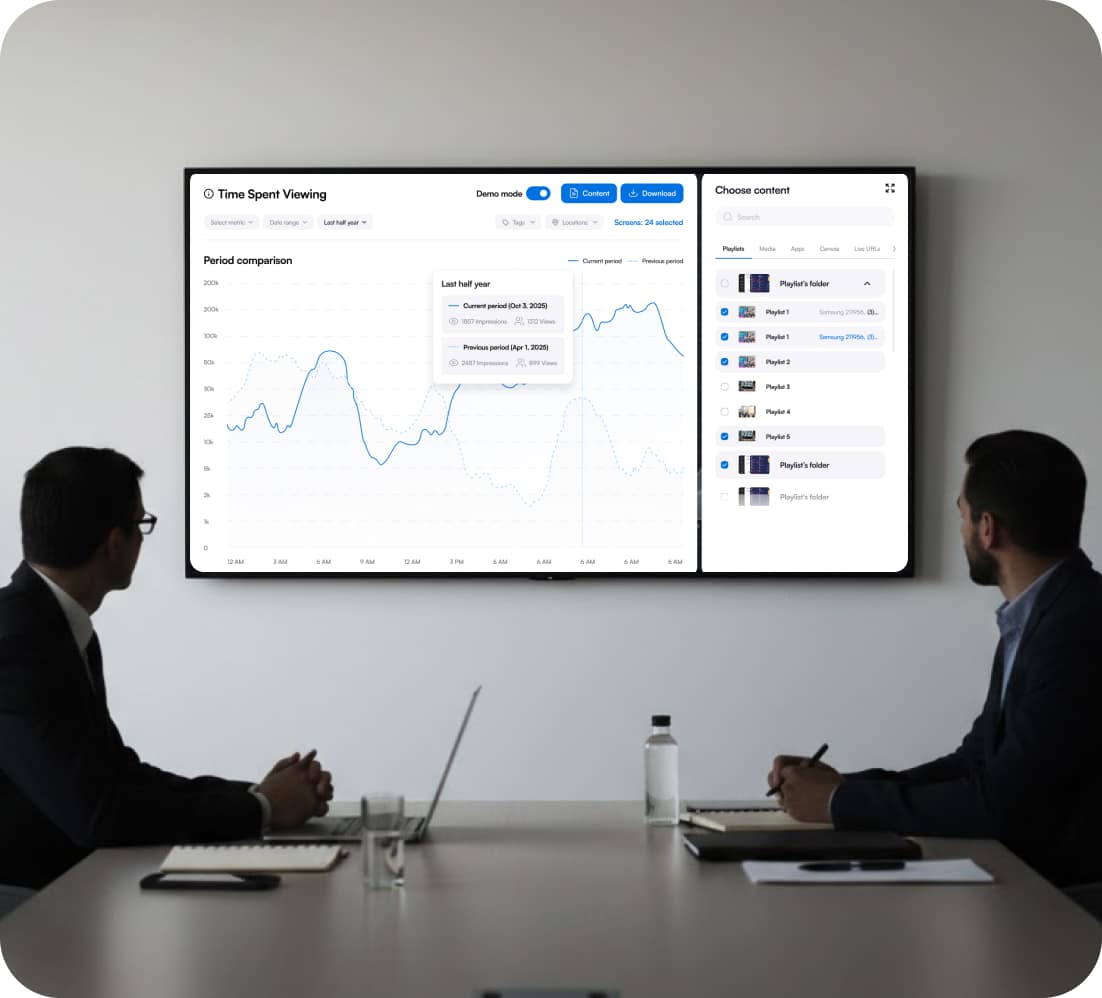
7 Best Digital Signage Software Companies for Analytics and ROI

Best digital signage software companies for analytics and ROI are getting more attention because businesses want more than screens that simply play content. They want digital signage software that can track engagement, support better content management, and prove business value across multiple screens and multiple locations. Grand View Research says the global digital signage market was estimated at $31.09 billion in 2025, and Mood Media reported that 58% of shoppers actively notice in-store displays, showing why analytics and ROI now matter much more in digital signage decisions.
In this article, you will learn which digital signage software companies stand out for analytics, how they compare on software, features, templates, and pricing, and which platform is the right digital signage solution for different business needs. You will also see how digital signage analytics connects to ROI digital signage analytics, what metrics matter most, and why AIScreen stands out as a leading provider for businesses that want user friendly control, scalable digital signage, and better performance tracking.
Why Digital Signage Analytics Matter?

Digital signage analytics matter because no business would launch a website, ignore visits and behavior, and still expect strong results. The same idea applies to digital signage software.
If a company is using digital displays across multiple screens, multiple locations, or a full digital signage network, analytics helps it move beyond simply showing content and start understanding what is actually working.
A screen should not just run digital signage content. It should support smarter business decisions. Digital signage analytics turns a digital signage solution into something measurable.
It helps businesses understand whether their signage software is improving customer engagement, supporting internal communications, strengthening visual communications, or delivering better display content across retail stores, corporate offices, and educational institutions.
Intel has reported that digital signage can attract over 400% more views than static signage, which shows why performance tracking matters once screens go live.
Key benefits of digital signage analytics:
- It gives visibility into impressions, dwell time, attention, and audience engagement instead of relying on guesswork.
- It shows which digital content, social media feeds, digital menus, or multimedia content is working well and which should be replaced.
- It connects digital signage software performance to real goals such as conversion, sales lift, and targeted messaging.
- It supports optimization through better content scheduling, dynamic content delivery, and stronger content creation decisions.
- It improves accountability by helping teams explain the value of a digital signage investment.
This matters even more in retail stores, digital menu boards, and corporate environments where every screen, every media file, and every software solution carries a cost.
The right digital signage solution should help with managing digital displays, remote content management, centralized control, and remote device management, but it should also prove impactful. That is what makes scalable digital signage more useful for businesses trying to improve results across digital screens.
For companies comparing the best digital signage software for analytics, this is often the real difference between simply running signage and building a system that performs.
The best digital signage software should combine key features like a user friendly interface, multi user access, customizable templates, cloud services, content scheduling, interactive features, and centralized dashboard reporting.
When these core features are supported by analytics, organizations can manage content more confidently and deliver dynamic and engaging content across digital signage players, cloud based platform tools, and different operating systems.
What Are the Best Digital Signage Software Companies for Analytics?
The best digital signage software companies for analytics depends on what a business wants to measure. Some teams care most about proof of play, some focus on audience engagement, and others want stronger content management, remote management, and centralized control across multiple locations.
The strongest digital signage software companies usually combine analytics with content scheduling, multi screen support, and the ability to manage content across a full digital signage network. Your own notes make that point clearly, and they also show why cloud based deployment keeps gaining ground for scalable digital signage.
A good shortlist should not just look at digital displays and dashboards. It should also look at how well the signage software handles digital signage content, dynamic content delivery, multiple screens, remote content management, and user friendly workflows.
Cloud-based deployment models are expected to account for 65.5% of digital signage software installations by 2037, which is one reason businesses now expect centralized dashboard access, remote device management, and easier control across corporate environments, retail stores, and educational institutions.
Below are the platforms that stand out in your source notes, with AIScreen covered in more detail and the rest kept in a shorter comparison format. Your original notes also highlighted L Squared, Visix, Scala, BrightSign, XIBO, and NoviSign as strong options for analytics-driven signage software.
AIScreen

AIScreen is one of the best and strongest options here for businesses that want a user friendly interface, strong content management, and practical analytics without making the platform feel complicated.
It is built for managing digital displays across multiple screens and multiple locations, which makes it a natural fit for retail stores, corporate environments, digital menu boards, internal communications, and other businesses that need centralized control.
AIScreen’s own site positions it as a cloud-based digital signage platform with remote content management, scheduling, and visual content tools designed for fast deployment and ongoing control.
Software
Software covers the core work most teams actually need from digital signage software. It supports cloud services, digital signage players, content scheduling, split-screen layouts, offline playback, and centralized dashboard management.
That makes it useful for enabling businesses to manage content, schedule content, and deliver dynamic content across a growing digital signage network. It also fits businesses that want scalable digital signage and better control over digital signage content across multiple screens.
- cloud based platform
- digital signage players
- content scheduling
- split-screen layouts
- offline playback
- centralized dashboard
- remote content management
- scalable digital signage
- multi-screen support
- manage content from one place
Features
Features become more competitive because the platform combines advanced features with an intuitive interface. The features help businesses streamline content management, improve audience engagement, and handle remote device management more easily.
- unlimited users
- split screen zones
- offline mode
- apps and integrations
- social media feeds support
- google slides support
- remote device management
- multi user access
- dynamic content delivery
- user friendly interface
- centralized control
- interactive features
Templates
Templates are a major advantage for businesses that want faster content creation without losing quality.
- 1,500+ customizable templates
- ready-to-use layouts
- faster content creation
- useful for digital menus
- useful for internal communications
- supports visual messaging
- supports dynamic and engaging content
- professional digital signage look
Pricing
- Free plan available
- Business plan starts at $74.99
- annual savings messaging shown
- 14-day free trial
- public pricing page
- easier to compare before buying

L Squared
L Squared is a solid digital signage company for businesses that want structured content management, analytics, and enterprise-ready control across multiple screens. It is often better suited to larger organizations, corporate offices, healthcare, retail stores, and educational institutions that need a content management system with stronger operational depth.
The platform is known for supporting centralized control, remote management, and scalable digital signage, making it a good fit for teams that want a professional digital signage solution with more enterprise-style workflows.
Features:
- enterprise content management
- analytics tools
- multi-screen support
- remote management
- centralized control
- customizable templates
- cloud and on-premise options
- security-focused setup
- widget support
- integration support
Visix
Visix is a practical choice for organizations that want flexible digital signage software for internal communications, educational institutions, and corporate environments. It is known for helping teams manage digital content from one centralized point while also supporting collaborative workflows.
That makes it useful for businesses that want better visual communications, user-level content control, and an intuitive interface for managing digital displays across departments or locations.
Features:
- centralized control
- collaborative content management
- user friendly interface
- internal communications support
- content scheduling
- integration capabilities
- customizable content workflows
- corporate communication tools
Scala
Scala is a strong option for businesses that want advanced visual messaging, interactive capabilities, and analytics within a more enterprise-focused digital signage platform. It is often chosen by brands that care about high-impact display content and dynamic content delivery across digital screens.
The platform stands out for combining creative content tools with professional digital signage workflows, making it suitable for organizations that want both design quality and reporting depth.
Features:
- analytics support
- dynamic content delivery
- interactive features
- advanced design tools
- media-rich content support
- enterprise deployment
- customizable templates
- content scheduling
- visual messaging tools
BrightSign
BrightSign is best known for combining reliable hardware with digital signage software, making it a good choice for businesses seeking dependable performance across a larger digital signage network. It is especially relevant for organizations that care about digital signage players, remote device management, and managing digital displays at scale.
For companies that want a digital signage solution built around stability, deployment control, and hardware-software compatibility, BrightSign is often a strong contender.
Features:
- strong hardware integration
- digital signage players
- remote device management
- centralized control
- scalable deployment
- cloud connectivity
- reliable content delivery
- support for multiple screens
XIBO
Xibo is a flexible signage software option for businesses that want more control, customization, and a lower-cost path into digital signage. It is often appealing to technical teams because it supports open-source deployment and more tailored configuration options.
That makes it useful for organizations that want a customizable digital signage solution, especially when budget, flexibility, and control over the content management system matter more than polished out-of-the-box simplicity.
Features:
- open-source flexibility
- customizable platform
- content management system
- layout and template tools
- cloud or self-hosted options
- multi-screen support
- community-driven ecosystem
- budget-friendly setup
NoviSign
Novisign is a user friendly digital signage platform that works well for businesses looking for quick setup, easy content creation, and built-in analytics. It is often a strong fit for digital menu boards, retail stores, internal communications, and smaller teams that want to manage content without a steep learning curve.
Because it combines cloud based platform access, templates, and reporting tools, it is a good option for businesses that want dynamic and engaging content with simpler day-to-day management. NoviSign features comprehensive proof-of-play reporting and analytics for retail and corporate settings.
NoviSign powers over 60,000 screens across five continents, delivering a complete cloud-based solution for managing digital content.
Features:
- built-in analytics
- proof-of-play reporting
- drag-and-drop content creation
- customizable templates
- content scheduling
- cloud based platform
- monitoring dashboard
- digital menu support
- intuitive interface
- multi-screen support
Other softwares includes:
- ScreenCloud features an app marketplace with 80+ integrations that turn screens into live intelligence dashboards. ScreenCloud provides user-friendly AI tools and analytics for tracking engagement. ScreenCloud features real-time monitoring and AI-powered recommendations based on viewer demographics.
- TelemetryTV specializes in high-volume display fleets and data-driven retail. TelemetryTV is known for advanced analytics, proof-of-play reports, and comprehensive data integrations for enterprise clients.
- Navori Labs uses AI-computer vision to provide deep marketing analytics and identify viewer demographics.
- NaviQ features AI-enhanced digital signage with advanced analytics for audience measurement and content personalization.
- OptiSigns’ “Audience Intelligence” AI camera system detects age, gender, and engagement levels to personalize displayed content.
- Rise Vision offers a cloud-based digital signage platform that integrates screen sharing and emergency alerts.
- Yodeck is known for its agile digital signage and gamification platform that offers multi-screen support and an extensive template repository.
- Mandoe Media is a global leader in digital signage, enabling businesses to create and display visual content easily.
- Omnivex software helps organizations simplify the management of their digital signage network by allowing users to collect and present targeted real-time information.
What is the Link Between Analytics and ROI
The link between analytics and ROI becomes clear when a business stops treating digital signage as just a screen and starts treating it as a measurable business tool. Analytics shows what is happening across digital displays, while ROI shows whether that activity is creating value.
Together, they help businesses understand whether their digital signage software is improving customer engagement, content performance, and overall business results across multiple screens and multiple locations.
The global digital signage software market is projected to grow from $11.43 billion in 2024 to $12.96 billion in 2025, reflecting a compound annual growth rate (CAGR) of 13.4%.
Analytics to Insight
Analytics to insight is the first step because a business needs clear data before it can make better decisions.
A strong digital signage solution can track impressions, dwell time, engagement actions like QR scans or touches, conversion signals such as coupon redemptions or POS response, and even operational performance like uptime and playback verification. These insights help businesses move past assumptions and understand how their digital signage content is actually performing.
- impressions near the screen
- dwell time and attention
- QR scans and touch engagement
- coupon redemptions or sales response
- uptime and playback verification
- visibility into audience behavior
Insight to Optimisation
Insight to optimisation happens when the data starts guiding changes. Once businesses can see what works, they can replace underperforming display content, improve content scheduling, adjust dayparts, reposition digital screens, and deliver more targeted messaging.
This is where signage software becomes more valuable because it allows teams to manage content, test dynamic content, and improve visual messaging based on real audience behavior instead of guesswork.
- swap weak content with stronger content
- adjust content scheduling by time of day
- reposition digital displays for better visibility
- tailor messages to audience behavior
- improve dynamic content delivery
- refine content creation decisions
Optimisation to ROI
Optimisation to ROI is where business value becomes easier to measure. As content gets better, audience engagement can improve, conversions can rise, and operational costs can fall through faster updates and reduced printing.
That is how digital signage ROI becomes more visible. Instead of only proving that content played, businesses can show that their digital signage network supported sales, improved internal communications, boosted customer engagement, or reduced manual content management effort.
- better engagement can support higher conversions
- faster updates can reduce print-related costs
- stronger targeting can improve campaign performance
- remote management can save time across multiple locations
- measurable improvements make scaling easier
How to Track Digital Signage ROI Using Analytics Software

Track digital signage ROI using analytics software by following a clear process that connects screen performance to business outcomes.
The goal is not just to know what content played on digital displays, but to understand whether that digital signage content improved customer engagement, increased sales, reduced manual work, or made managing digital displays easier across multiple screens and multiple locations.
Define Objectives and KPIs
Define objectives and KPIs first so the digital signage solution supports real business goals. A retail business may want to increase average spend, drive more traffic to a promotional zone, reduce print costs, or improve waiting-time perception. A corporate office may focus more on internal communications, visual messaging, or audience engagement.
For industrial teams comparing the best digital signage software companies for manufacturing KPI dashboards, the goals may also include improving production visibility, reducing reporting delays, and keeping performance updates clear across multiple screens.
You can group KPIs into three simple layers:
- operational efficiency
- engagement
- business impact
Examples include:
- screen uptime
- content playback accuracy
- print cost reduction
- impressions
- dwell time
- interaction rate
- coupon redemption
- sales uplift
- customer satisfaction
Gather Cost Data
Gather cost data next because ROI depends on understanding the full cost of the digital signage software setup. This includes the obvious costs like digital screens and software solutions, but it also includes the ongoing work needed to run a professional digital signage network.
The cost for a professional on-premise license typically costs around $499. Most digital signage software companies adopt a subscription model, billing monthly or annually per screen or user. Pricing structures for digital signage software can vary widely, with some providers offering free trials and others requiring upfront payments.
Some digital signage platforms provide additional costs for features like data migration, on-site training, and hardware requirements.
Typical costs include:
- hardware such as displays and media players
- signage software or content management system licensing
- analytics tools or modules
- installation and setup
- content creation
- maintenance and support
- ongoing operations across multiple locations
This step gives businesses a more realistic view of what the right digital signage solution actually costs over time.
Quantify the Benefits
Quantify the benefits by using analytics to measure how the signage software changed performance. This is where dashboards, proof-of-play data, audience measurement, and conversion tracking become valuable. Proof of Play confirms when, where, and for how long content played, essential for advertising billing.
Common measurable benefits include:
- sales uplift from promoted products or zones
- print cost savings from reduced paper signage
- higher dwell time or interaction rate
- better audience engagement
- time saved through remote management
- faster content updates across multiple screens
You can also track softer benefits like stronger brand perception or better visual communications, although those are harder to assign a direct financial value.
Use Analytics Tools to Find Patterns
Use analytics tools to find patterns before making decisions. Some digital signage platforms focus on app integrations, some on audience measurement, and some on proof-of-play reporting or fleet-level reporting. That matters because not every business needs the same type of analytics.
Examples of useful capabilities include:
- proof-of-play reporting for playback confirmation
- audience measurement using cameras or sensors
- foot traffic and sales tracking near the point of purchase
- real-time monitoring for screen health and device uptime
- AI tools for engagement tracking and content recommendations
- integrations with dashboards, data feeds, and live intelligence tools
These features help businesses understand not just what played, but what actually influenced customer behavior.
Calculate ROI with a Formula
Calculate ROI with a formula once benefits and costs are clear. A common formula is:
- ROI = (Total Benefits – Total Costs) ÷ Total Costs × 100
This turns digital signage ROI into something measurable instead of something assumed. If the total benefit from sales lift, savings, and operational gains is higher than the total cost of hardware, software, labor, and content, the deployment is creating value.
Monitor and Optimise Over Time
Monitor and optimise over time because ROI is rarely fixed after one campaign. Audience behavior, seasonality, campaign timing, and content quality all affect performance.
A good digital signage software setup should help businesses test display content, refine content scheduling, and improve dynamic content delivery over time.
Useful optimisation actions include:
- replacing underperforming content
- changing dayparts
- moving digital displays to higher-traffic areas
- tailoring targeted messaging
- refining digital menus or promotional content
- improving content creation based on engagement data
This is where analytics turns into ongoing improvement instead of one-time reporting.
Connect Analytics to Other Systems
Connect analytics to other systems for more precise measurement. When a digital signage platform connects with POS, CRM, inventory, web analytics, or scheduling tools, it becomes easier to link screen activity to real business outcomes.
That is especially important for retail stores, digital menu boards, and high-volume environments where dynamic content and content scheduling need to react quickly. In these settings, POS marketing and digital signage work better together because businesses can align display content with product offers, pricing updates, and customer behavior in near real time.
This broader trend also matches the market direction. The global digital signage software market is projected to grow from $11.43 billion in 2024 to $12.96 billion in 2025, showing how fast businesses are investing in analytics, automation, and scalable digital signage.
Cloud-based deployment models are also expected to account for 65.5% of installations by 2037, which helps explain why centralized control, remote content management, and integration with other systems are becoming standard expectations.
How Do Digital Signage Software Companies Compare for Analytics?
Digital signage software companies compare for analytics, depending on the kind of reporting a business actually needs. Some platforms are better for proof-of-play and uptime visibility, some are better for enterprise content management, and others are stronger in ease of use, templates, or open-source flexibility.
The digital signage software market is projected to grow significantly, reaching $21.44 billion by 2029 and $77.09 billion by 2037.
Your notes also make it clear that the most useful platforms usually combine content scheduling, multi-screen support, analytics, remote management, and centralized control.
| Software | Analytics Strength | Best For | Key Analytics-Related Features | Ease of Use | Templates | Deployment Style |
|---|---|---|---|---|---|---|
| AIScreen | Strong practical analytics for day-to-day content performance and screen management | Retail stores, digital menu boards, internal communications, corporate offices | Centralized dashboard, remote content management, content scheduling, multi-screen control, integrations, offline playback | High | Strong | Cloud-based |
| L Squared | Strong enterprise analytics and performance tracking | Corporate environments, healthcare, education, retail | Advanced analytics, detailed CMS controls, multi-screen synchronization, cloud and on-premise options | Medium | Strong | Cloud and on-premise |
| Visix | Good analytics with strong content control | Educational institutions, corporate communication | Content management, scheduling, integrations, centralized control | High | Good | Web-based / enterprise |
| Scala | Strong built-in analytics with creative control | Brands that want visually rich campaigns and performance insight | Built-in analytics, advanced design tools, dynamic content support | Medium | Good | Enterprise / custom |
| BrightSign | More operations-focused than marketing-analytics-focused | Large networks that need stability and remote device management | Remote management, hardware-software integration, reliable playback control | High | Moderate | Hardware-led ecosystem |
| XIBO | Basic to moderate analytics with strong flexibility | Budget-conscious and technical teams | Customizable CMS, self-hosted or cloud-hosted control, multi-screen support | Medium | Moderate | Open-source, cloud, self-hosted |
| NoviSign | Strong for easy reporting and proof-of-play style visibility | Small businesses, retail, corporate settings | Analytics, proof-of-play reporting, monitoring dashboard, drag-and-drop workflows | High | Strong | Cloud-based |
Why Businesses Choose AIScreen for Digital Signage Analytics
Businesses choose AIScreen for digital signage analytics because it brings together the tools that matter most in one place. It helps teams manage digital displays, track content performance, control multiple screens across multiple locations, and keep digital signage content organized without adding unnecessary complexity. That balance of user friendly interface, strong content management, customizable templates, and practical analytics is what makes it a reliable digital signage solution for modern businesses.
AIScreen stands out as a leading provider because it gives businesses a simple way to connect digital signage software with real business results. Instead of only showing content on digital screens, it helps organizations improve customer engagement, streamline internal communications, and manage content with more confidence. For companies looking for the right digital signage solution, AIScreen offers a practical mix of software solutions, centralized control, and scalable digital signage that supports long-term growth. Contact us.
FAQs
Can small businesses use digital signage analytics effectively?
Yes, small businesses can use digital signage analytics effectively when they focus on a few clear goals such as customer engagement, content performance, and sales response. They do not need a complex digital signage network to benefit. Even a simple setup with digital displays, content scheduling, and basic reporting can help them manage content better and make smarter decisions.
Which analytics metrics matter most for digital signage success?
Analytics metrics matter most for digital signage success when they connect screen activity to business outcomes. The most useful ones usually include impressions, dwell time, interaction rate, playback accuracy, uptime, and conversion response. Together, these metrics help businesses understand whether their digital signage content is attracting attention and supporting real results.
Can digital signage analytics improve internal communications?
Yes, digital signage analytics can improve internal communications by showing whether employees are actually seeing and responding to display content. In corporate offices and other workplace settings, this helps teams refine visual messaging, improve content delivery, and make internal communications more relevant across multiple screens and multiple locations.
How often should businesses review digital signage analytics reports?
Businesses should review digital signage analytics reports regularly enough to spot trends before they become missed opportunities. For most organizations, weekly or monthly reviews work well, while faster-moving campaigns may need closer monitoring. Regular review helps teams improve content scheduling, update digital content faster, and keep display performance aligned with audience behavior.
What makes a digital signage platform better for analytics than a basic screen solution?
A digital signage platform better for analytics than a basic screen solution usually means the software can do more than just play media files. A stronger platform supports reporting, proof of play, remote management, centralized control, and better content management. That gives businesses a clearer way to measure performance and improve their digital signage ROI over time.