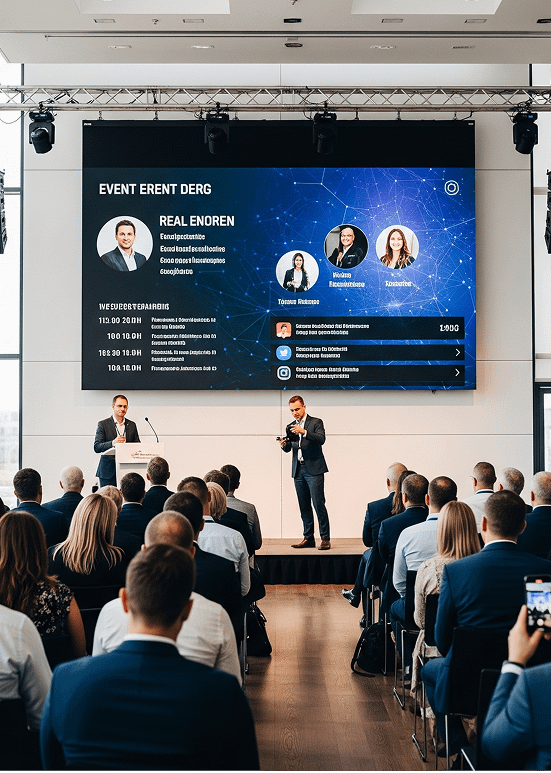
6 Best Digital Signage Software Providers for Events

Are you planning an event and wondering if 6 best digital signage software for events to boost engagement is really worth the switch from printed boards? The short answer is yes, because screens don’t just display information anymore, they drive interaction. In fact, Linney reports digital signage has a 47.7% effectiveness on brand awareness, which is exactly what sponsors and event teams want when they invest in on-site visibility.
In this blog post, you’ll learn what event digital signage software is, how social walls boost live participation, which six platforms are most event-ready in 2026, and what features to prioritize for fast setup, real-time updates, analytics, and smooth multi-screen control. Explore our event digital signage solution, or see our convention center digital signage option for larger venues.
What Is Digital Signage Software for Events?
Walk into any modern conference in 2026 and you’ll notice one thing immediately, screens have replaced paper.
Digital signage software for events is a cloud-based control system that powers LED walls, kiosks, social walls, registration screens, sponsor displays, and wayfinding boards from one centralized dashboard.
An advanced event digital signage platform connects every screen into a single digital signage network, allowing organizers to push live updates instantly.
Unlike static print signage, a modern digital signage solution enables real-time content changes, social media integrations, analytics tracking, and remote management.
Digital event signage includes high-resolution displays and interactive event displays that showcase schedules, announcements, sponsor ads, and user-generated content. Tools like Taggbox power social walls that display live hashtags and posts, increasing audience engagement.
The impact is measurable. The global digital signage market is projected to exceed $45 billion by 2030, and digital displays can increase brand recall by 83%. Events using interactive technology report up to 50% higher engagement, while digital screens can boost dwell time by 30%.
Today, scalable digital signage is no longer optional, it’s essential infrastructure for conferences, expos, and brand activations.
Which 6 Best Digital Signage Software Options Are Ideal for Events?
Choosing the right platform can make or break a live event. Which 6 best digital signage software options are ideal for events depends on scalability, real-time update capability, engagement tools, deployment speed, analytics depth, and pricing flexibility.
For this curated comparison, we evaluated each platform based on:
- Cloud architecture and live update speed
- Multi-screen synchronization and scalability
- Engagement features (QR, social walls, interactivity)
- Reliability for high-traffic environments
- Ease of deployment for temporary event setups
- Analytics and reporting depth
- Pricing flexibility
Below is a structured comparison of six leading providers.
AIScreen

If your event demands real-time control, synchronized screens, and audience interaction at scale, AIScreen is built for it. AIScreen is the best digital signage software for events, designed specifically for high-impact, high-traffic, real-time environments.
Unlike legacy systems, AIScreen runs on a cloud-native architecture that enables instant content updates across LED walls, smart TVs, kiosks, tablets, and video walls.
Its centralized event dashboard allows organizers to control multiple venues, halls, or cities from one interface, making it ideal for expos, conferences, brand activations, and multi-location events.
Key event-focused capabilities include:
- Drag-and-drop Canvas editor for rapid content creation
- Remote screen pairing in minutes (ideal for temporary setups)
- Multi-screen synchronization for keynote stages and LED walls
- Social wall integrations and QR-based engagement
- Emergency broadcast capability
- Sponsor rotation scheduling
- API integrations with CRM, POS, ticketing, and data tools
- Offline playback protection for uninterrupted performance
- Advanced analytics and audience engagement metrics
AIScreen’s scalable digital signage infrastructure ensures smooth performance even under peak traffic conditions. Its pricing model supports everything from single-day events to global exhibition networks, making it a highly flexible digital signage solution.
Software Overview:
Cloud-based platform with centralized control dashboard, real-time updates, multi-location management, offline failover, and advanced engagement tracking.
Key Verticals:
Events, conferences, expos, retail activations, corporate communications, hospitality, QSR, education.
Top Clients:
Used globally across high-traffic business environments and multi-location deployments.
CAYIN Technology Co., LTD

When reliability and industrial-grade stability are the priority, CAYIN stands out. CAYIN Technology Co., LTD focuses heavily on hardware-backed stability and enterprise-scale deployments.
CAYIN delivers SMP industrial media players designed for 24/7 operation and integrates with CMS-SE servers capable of managing up to 4,000 players. Their approach emphasizes long-term stability over consumer-grade flexibility, making it suitable for mission-critical projects.
Software Overview:
CMS-SE centralized management system paired with industrial SMP players. Offers Flexie (cross-platform deployment) and Robustie (maximum stability integration) solutions.
Key Verticals:
Retail, hospitality, corporate, education, transportation, finance, government.
Top Clients:
IKEA Philippines, Amway Thailand, FamilyMart Taiwan, Westin Desaru Coast Resort, Bucharest Public Transport, SABIC Academy.
Mvix

Some organizations prefer a bundled, ROI-focused deployment model. Mvix offers a cloud-based CMS with a perpetual license model bundled with proprietary hardware.
Mvix emphasizes playlist management, advanced scheduling, multi-role user controls, and reporting. It is positioned as a turnkey solution for businesses seeking predictable cost structures without subscription dependency.
Software Overview:
Cloud CMS with one-time licensing, automated scheduling, smart playlists, monitoring tools, and bundled media players.
Key Verticals:
Corporate offices, healthcare, manufacturing, airports, government, education.
Top Clients:
NASA, Caesars Entertainment, Marriott, Verizon, Timberland.
SpinetiX

Precision engineering meets digital signage automation. SpinetiX delivers a Swiss-engineered, end-to-end ecosystem combining hardware players with ARYA cloud CMS and HUB management.
Its Digital Signage as a Service (DSaaS) approach integrates automation, security, and centralized control into one unified infrastructure. It focuses strongly on enterprise-grade reliability and scalable deployments.
Software Overview:
SpinetiX HUB for player management and ARYA cloud CMS for content control within a secure, automation-driven ecosystem.
Key Verticals:
Corporate, luxury retail, manufacturing, government, hospitality, education.
Top Clients:
PSG Stadium, Equifax, Fannie Mae, Alberta Health Services, US Armed Forces.
Coates Group

Restaurants require precision scheduling and menu control at scale. Coates Group specializes in QSR and restaurant ecosystems with its Switchboard™ CMS.
The platform emphasizes campaign management, dayparting, centralized content repositories, and integration with restaurant operational systems. It is particularly strong in global quick service restaurant deployments.
Software Overview:
Switchboard™ CMS for centralized restaurant content control, location tagging, playlist targeting, and campaign deployment.
Key Verticals:
Quick service restaurants, retail, transportation, petrol, education, government.
Top Clients:
Global QSR brands and large multi-location restaurant chains.
Omnivex

For enterprises driven by data consolidation and compliance, analytics matter most. Omnivex positions itself as a data-driven digital signage solution built for mid-to-large enterprises.
Its strength lies in consolidating data from multiple systems and delivering targeted real-time information across complex digital signage networks. It also offers strong emergency notification capabilities and monitoring tools.
Software Overview:
Enterprise software for collecting, processing, and delivering targeted data across multiple screens with advanced monitoring and reporting.
Key Verticals:
Airports, transportation, education, hospitality, stadiums, healthcare, government, manufacturing, banking.
Top Clients:
Minneapolis-Saint Paul International Airport, Vancouver International Airport, Carhartt, Calgary Stampede, Reid Health.
What are the Key Benefits of Using Digital Signage Software in Events

Events are no longer just about stage lights and speakers, they’re about intelligent communication.
What are the key benefits of using digital signage software in events? From higher attendance to measurable sponsor ROI, modern signage software transforms how organizers communicate, engage, and optimize performance.
Research shows digital displays generate 400% more views than static signage, while events using interactive screens report up to 20% higher attendance. Here’s how powerful digital signage software delivers measurable results.
1. Higher Event Attendance and Foot Traffic
First impressions start before the event even begins. Higher event attendance and foot traffic are often driven by dynamic pre-event promotions, countdown timers, and live agenda boards displayed across venues and partner locations.
Dynamic digital signage, especially high-resolution LED walls, naturally attracts attention. Visual displays are proven to capture 63% more attention than static posters, making them powerful promotional tools.
When organizers deliver dynamic content consistently across multiple screens, they create anticipation that translates into real foot traffic increases.
For expos and trade shows, digital promotions placed strategically near entrances or partner spaces can directly boost sales opportunities and session attendance.
2. Real-Time Event Updates and Notifications
Nothing disrupts an event faster than miscommunication. Real-time event updates and notifications allow organizers to instantly publish changes across multiple screens using cloud-based signage software.
With a centralized content management system, teams can push live agenda changes, speaker swaps, or emergency alerts within seconds. Emergency override features ensure safety messaging appears immediately across the entire digital signage network.
This operational efficiency reduces staff workload and improves customer satisfaction. Instead of printing updates or sending mass emails, organizers rely on advanced tools built into modern signage software to deliver dynamic updates instantly.
3. Stronger Audience Engagement and Interaction
Passive audiences are a thing of the past. Stronger audience engagement and interaction happen when attendees can participate through social walls, QR scans, live polls, and hashtag displays.
Interactive modules built into the best digital signage platforms increase customer engagement by encouraging attendees to post content, vote in real time, and participate in gamified experiences. Studies show interactive displays can increase engagement rates by up to 50%.
When digital signage content stays fresh and responsive, dwell time increases, and longer dwell time directly improves brand recall and sponsor impact.
4. Enhanced Sponsor Exposure and Brand Visibility
Sponsors don’t just want visibility, they want measurable ROI. Enhanced sponsor exposure and brand visibility become possible through automated sponsor rotation, dynamic video ads, and real-time impression tracking.
Unlike printed banners, signage software allows sponsors to rotate across digital menu boards, LED walls, kiosks, and stage screens. Impression analytics and dwell-time measurement provide post-event performance reports that help justify sponsorship investments.
The ability to deliver dynamic video ads across multiple screens significantly increases perceived brand value and can boost sales for featured sponsors during the event itself.
5. Sustainable and Cost-Efficient Event Communication
Printed signage is expensive and wasteful. Sustainable and cost-efficient event communication is one of the most practical benefits of using digital signage software.
Instead of printing thousands of posters that become useless after one day, organizers reuse customizable templates and update digital signage content instantly. This reduces paper waste and lowers logistics costs.
Many platforms support flexible annual plans, scalable pricing, and even free version trials for small businesses testing the technology. By eliminating recurring print expenses, events can redirect budgets toward experience-driven enhancements.
6. Seamless Event Navigation and Wayfinding
Large venues can easily overwhelm attendees. Seamless event navigation and wayfinding improves attendee flow and reduces confusion.
Interactive venue maps, session directories, QR-based navigation links, and multi-floor guidance screens help visitors find sessions quickly. When signage software integrates with operating systems across smart TVs, kiosks, and LED boards, navigation becomes centralized and easy to manage.
Clear wayfinding reduces staff interruptions and improves customer satisfaction, especially at multi-hall conferences and festivals.
7. Actionable Engagement Tracking and Performance Insights
If you can’t measure it, you can’t improve it. Actionable engagement tracking and performance insights turn event data into strategic advantages.
Modern signage software includes analytics dashboards that track impressions, dwell time, content performance, and audience behavior. Organizers can analyze which sessions attracted the most attention, which sponsor ads performed best, and how long attendees engaged with specific displays.
These insights help refine future events, select the right solution for scaling, and optimize digital signage strategies for better ROI. For small businesses and large enterprises alike, data-driven decision-making ensures every screen works harder.
What are the Types of Events Where Digital Signage Software Works Best
Not every event looks the same, and that’s exactly why flexibility matters. The types of events where digital signage software works best lies in scalability. Modern cloud based digital signage adapts to venue size, audience type, technical complexity, and business objectives.
Whether it’s a single screen setup at a workshop or an unlimited number of screens across multi-hall expos, today’s cloud based digital signage systems allow organizers to manage content centrally.
With compatible hardware running on Android, Chrome OS, or dedicated players like a Yodeck player, event teams can deploy screens quickly without complex infrastructure. From corporate gatherings to public awareness campaigns, signage software works across nearly every event format.
1. Corporate Conferences and Business Events
When hundreds or thousands of professionals gather, clarity and coordination are everything. Corporate conferences and business events rely on digital signage to display session schedules, keynote live streams, sponsor branding, and internal communications.
Large conferences often use multiple screens across breakout rooms, lobbies, and main stages to keep attendees informed. Organizers can update content instantly from a central dashboard, ensuring schedule changes reflect across every screen.
Digital signage also integrates with internal business systems to showcase employee spotlights, quarterly achievements, or leadership announcements. For annual summits or year-end awards, LED walls and video displays elevate the experience while maintaining professional branding consistency.
With scalable hardware options and flexible annual subscription models, signage software supports both single screen boardroom events and enterprise-level deployments.
2. Product Launch and Brand Reveal Events
Few moments are as high-pressure as unveiling a new product. Product launch and brand reveal events use immersive LED walls, synchronized product reveals, teaser countdowns, and social amplification to create impact.
Large-format screens create cinematic product introductions, while synchronized playback across multiple screens ensures timing precision. Brands can integrate live social feeds, early customer testimonials, and countdown timers to build anticipation.
For outdoor brand activations, organizers often explore what is DOOH digital signage, referring to Digital Out-of-Home screens placed in high-traffic areas to amplify launch visibility beyond the venue.
Cloud based digital signage enables seamless coordination between indoor screens and external promotional displays. Whether using proprietary hardware or third-party media players like a Yodeck player, event teams can maintain consistent messaging across all locations.
3. Trade Shows and Exhibitions
In crowded exhibition halls, visibility equals opportunity. Trade shows and exhibitions depend on digital signage to manage booth directories, interactive maps, exhibitor promotions, and real-time announcements.
With dozens or hundreds of screens across a venue, organizers can guide attendees through complex floor plans. Interactive kiosks allow visitors to search booth numbers, while LED displays promote keynote sessions or sponsor activations.
Businesses exhibiting at trade shows also use digital signage to showcase product demos, promotional videos, and limited-time offers. Being able to update content throughout the day keeps messaging relevant and aligned with audience flow.
Because trade shows often involve temporary setups, compatibility with flexible hardware and fast deployment across Chrome OS devices or plug-and-play players becomes critical.
4. Healthcare and Wellness Campaign Events
Information and trust are central in healthcare environments. Healthcare and wellness campaign events use digital signage to share awareness messages, educational content, patient testimonials, and workshop updates.
Large public health campaigns may use screens to display real-time statistics, prevention tips, or live Q&A feeds. Interactive displays can collect audience questions via QR codes, increasing engagement without disrupting sessions.
Hospitals and wellness conferences often operate across multiple buildings, requiring signage systems that support an unlimited number of screens without complex rewiring. Cloud based digital signage ensures messaging remains consistent while allowing local teams to update content when needed.
The right solution reduces printing waste and ensures sensitive updates can be communicated instantly.
5. Educational Conferences and Academic Events
Campuses are dynamic environments where information changes constantly. Educational conferences and academic events rely on digital signage for seminar scheduling, campus wayfinding, faculty spotlights, and live Q&A feeds.
Universities hosting academic summits use screens to display real-time agenda updates, research highlights, and student achievements. During convocations or award ceremonies, large displays recognize graduates while live social feeds showcase celebrations.
Interactive screens also support live polling and competition results, making sessions more engaging for students and faculty alike.
Educational institutions benefit from cost-effective annual subscription options and scalable hardware compatibility, allowing both small businesses in training sectors and large universities to deploy signage efficiently.
Why AIScreen Is the Smart Choice for Event Digital Signage Software
In 2026, events demand speed, flexibility, and measurable results. AIScreen stands out as the leading provider and the best digital signage software for events because it combines cloud scalability, rapid deployment, real-time engagement tools, advanced analytics, and hardware flexibility in one powerful platform. From sponsor automation to multi-screen synchronization, everything is managed from a single centralized dashboard.
Whether you’re running a single venue or a multi-city expo, AIScreen makes it easy to launch, manage, and scale your event signage without complexity. Its performance reliability, intuitive interface, and ROI-driven design make it a future-ready event signage infrastructure platform built for modern conferences, brand activations, and large-scale experiences. Contact us.
FAQs
How does digital signage software improve audience engagement at live events?
Digital signage software improves audience engagement at live events by turning passive viewers into active participants. Features like live polls, QR scans, hashtag displays, and interactive screens increase customer engagement and dwell time.
Can digital signage software integrate with social media platforms for social walls?
Digital signage software can integrate with social media platforms for social walls through API connections and real-time content feeds. Event organizers can display live hashtags, user-generated posts, and mentions instantly on screens. This dynamic content keeps audiences involved, increases brand visibility, and helps businesses amplify event reach beyond the venue.
What features should you look for in event digital signage software?
Features you should look for in event digital signage software include a cloud-based content management system, real-time updates, multi-screen synchronization, social wall integrations, analytics dashboards, emergency alerts, and scalable hardware compatibility. Advanced tools, customizable templates, intuitive interface design, and flexible annual subscription plans also ensure you choose the right solution for your business.
Is digital signage software suitable for small-scale events and conferences?
Digital signage software like AIScreen is suitable for small-scale events and conferences because it supports everything from a single screen setup to an unlimited number of screens. Many providers offer flexible pricing, including free version trials and scalable annual subscription options, making it accessible for small businesses while still delivering professional-grade performance.
How quickly can digital signage software be set up for an event?
Digital signage software can be set up for an event in just a few hours depending on the hardware and network environment. Cloud based digital signage like AIScreen allow organizers to pair screens remotely, upload content, and publish instantly. With plug-and-play hardware and simple configuration across supported operating systems, deployment is fast and efficient.