
What Are the Top 9 Benefits of Digital Signage?
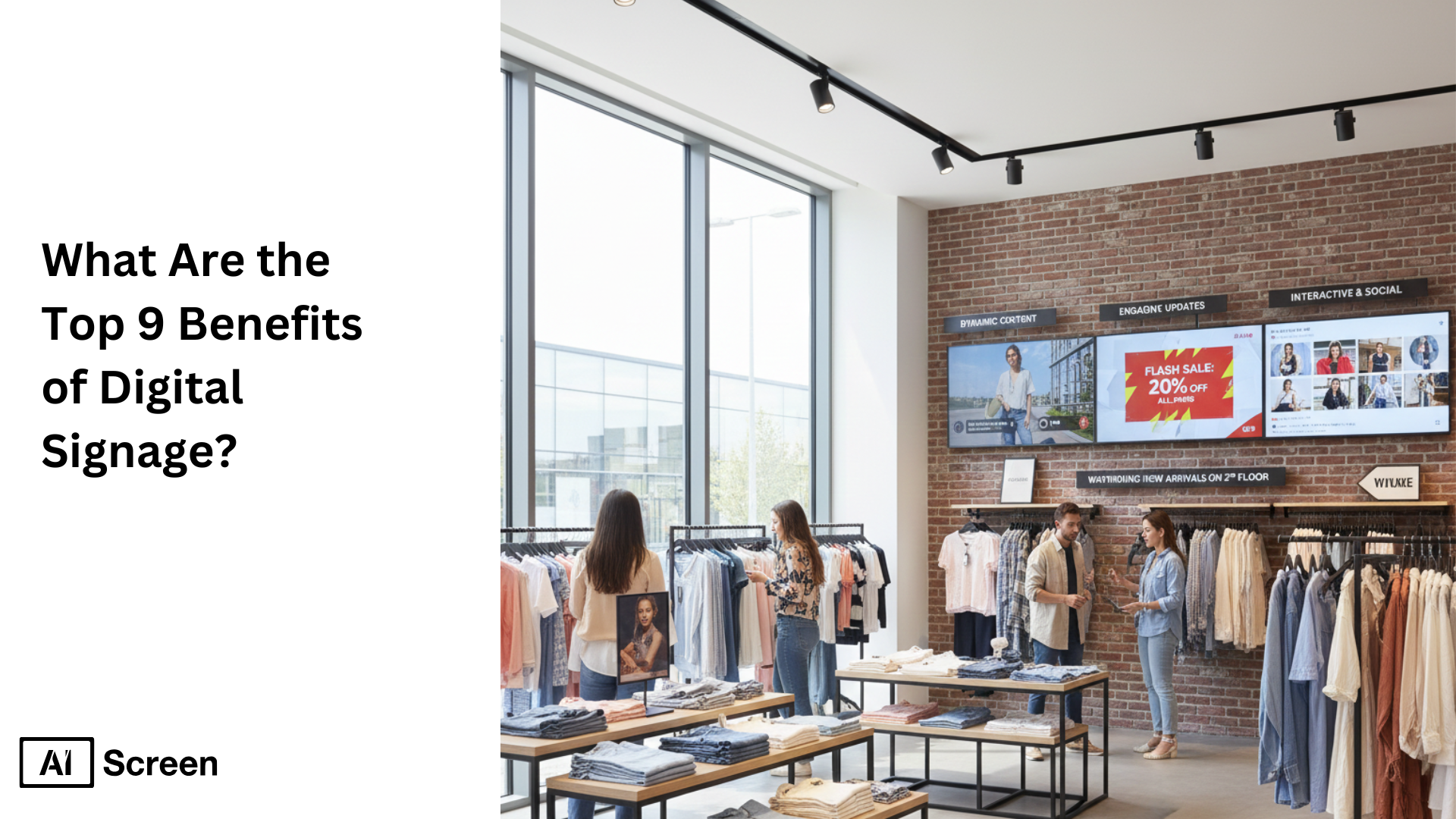
Digital signage benefits include increased customer engagement, enhanced brand awareness and reduced advertising expenses. Digital signage has a lot of advantages and benefits like better customer engagement, increased brand visualisation and cost-effective advertising. AIScreen’ team search out that according to Statista, the global digital signage market is projected to reach $45 billion by 2030, showing how rapidly businesses are adopting this technology to stay competitive.
In this blog post, you will discover how digital signage can be used to provide real-time updates, dynamic content, and personalized experiences that resonate with audiences. We will also look at how it can boost sales, improve internal communication and even help promote “green initiatives” by decreasing the printed materials used. At the end, you’ll know why digital signage is a versatile tool for any industry, no matter how small and how many the key benefits of digital signage are.
What Is Digital Signage?
Have you ever wondered how the posters around you are replaced or the signs are reprinted seemingly instantaneously? Digital signage is a new technology for presenting information on digital displays, which can be changed centrally rather than manually by someone updating the printed signage.
Digital signage provides screens, such as digital displays, digital signage monitors or large format display screens, to display information or content, which may include things like announcements, promotions, directions, menus or real-time updates. From retail shops to offices, from airports to public areas, these types of screen can be seen as a single screen, a video wall, a kiosk or an information board.
The real difference of digital signage is the core platform that is used. With digital signage software, companies can change content at a moment’s notice on a single screen or hundreds of screens from one central location.
This real-time messaging capability is one of the greatest digital signage features, which makes communication even faster, more consistent, and much more flexible than printed signage could ever be.
What Are the 9 Benefits of Digital Signage That You Shouldn’t Overlook
If you look beyond the screens themselves, the real value shows up in results. You can’t ignore the advantages of digital signage when you see the impact it has on marketing, day-to-day operations and internal communication across various industries.
These are all the benefits of digital signage in one: growth, efficiency and engagement.
1. Increase Foot Traffic and Influence Purchasing Behavior
Sometimes a single moving image can be more powerful than a full week of promotions, that’s where the real change takes place. Drive foot traffic and influence purchasing by displaying digital signage near storefront windows and other entrances to catch attention and drive decision making before a customer enters the store.
The impact of movement is consistently shown with research. According to Nielsen, people view digital screens 400% more than static signs and 76% of shoppers have walked into a store after seeing a digital sign, according to Statista. The human brain is attuned to rapid recognition of motion, color and dynamic visuals that stop, or look and walk in.
At AIScreen, storefront signage is more than just a way to draw attention. The true opportunity is in coordinating the promotion to retail. A retailer can schedule a discount on their morning merchandise during the morning hours, shift to more popular items in the busier hours and offer clearance goods during non-busy hours with our scheduling tools. We’d be more interested in getting those messages in front of customers at the right time, rather than a specific ad running 24 hours a day.
How motion-driven content pulls people in:
- Animated visuals grab instant attention: Moving graphics and bold transitions naturally draw the eye, giving storefronts an advantage on busy streets.
- Real-time promotions spark impulse walk-ins: Limited-time offers or “today only” deals create urgency; McKinsey notes timely messaging can lift impulse purchases by 20–30%.
- Best-seller showcases guide behavior: Highlighting popular items leverages social proof, Harvard Business Review reports it can increase purchase intent by up to 40%.
- High-contrast imagery boosts visibility: Strong colors and sharp visuals help stores stand out from a distance, especially in crowded retail zones.
Once customers are inside, digital signage displays continue influencing decisions at shelves, counters, and checkout, turning attention into action within seconds.
2. Boost Brand Awareness and Revenue Growth
Strong brands are recognizable in any place you see them. Use digital signage content to ensure your visuals, messaging and tone remain consistent across multiple locations to elevate brand and revenue growth while driving campaigns to change rapidly.
The same brand image and messages are in circulation being seen on screens in stores, offices and public places; recall goes up, advertising isn’t repetitive.
This is one of the most obvious advantages of digital signage: to reinforce visibility while maintaining enough flexibility to promote seasonal campaigns, new product launches or timely updates without delay.
Brand consistency can be a challenge for companies who have multiple locations and that’s one thing we love about AIScreen. Teams can design branded content without creating each screen from scratch with our Aura Editor and customisable templates. For instance, a restaurant brand could keep the same colors, fonts and campaign graphics, but include varying offers in the individual locations. This is how we would do the “brand visibility”: a known name, with enough flexibility for content to be relevant locally.
3. Lower Perceived Waiting Times
Waiting in itself is frustrating, but it seems shorter when attention is engaged. Make waiting time seem shorter: In queues or waiting rooms use a screen, images or interactive kiosks to monitor and to keep people informed or entertained.
We have researched that according to the Statista retail checkout study, 84% of customers reported being satisfied with and more likely to return to retailers that provide digital displays for them to view while waiting in line. Digital signage ensures a better dwell time experience, more positive idle moments.
4. Increase Sales with Point-Of-Sale Influence Revenue
The last few moments before closing on a sale are the ones that make or break the sale. Timing is everything with a push to sales; location is key when considering where digital signage content can influence revenue, near aisles, shelves and checkout counters.
The timing of short offers, product pairings, reminder message types is best delivered when customers are in buying mode. One of the most tangible advantages of digital signage is this, particularly if advertising messages can be timed to coincide with busy times or certain product areas.
5. Improve Team Communication and Training
Not all updates are e-mail updates. Use internal screens to provide KPIs, recognition, safety reminders or brief training instructions and enhance team communication and training.
Digital signage content can be helpful in aligning information, as it remains prominently visible all day long, which decreases inbox overflow while reinforcing culture, performance targets, and learning through daily repetition.
6. Save Time and Reduce Printing Costs
More than most teams realize, print cycles slow things down. Eliminate repetitive printing and posters, while saving time by changing out digital signage content instantly.
Modifications of pricing, promotion, or messaging can be made and go live within a short span of time, eliminating delays in reprinting or distribution. This enhances efficiency of functioning without promising anything hard in the way of savings.
When considering AIScreen’s content management, the price of paper is not always the largest disparity with printed signage. The number of manual steps that go away. A business can setup a promotion inside the Aura system, schedule it on specific screens and remotely replace it when an offer has expired. No need to re-design, print, distribute and physically change posters at each site. We’d still always have to compare the hardware and subscription fees before we could state that digital signage invariably incurs cheaper costs.
7. Support Safety and Compliance Communications
If the information is very important, time is of the essence. Help keep safety and compliance communications visible by placing messages/signs on screens in high traffic areas.
In the world of digital signage for retail stores, it translates to safety notices and procedural messages being displayed in the areas that teams are already engaging with, and providing awareness and quicker communication is what this isn’t meant to supplant formal compliance systems.
8. Deliver Consistent Yet Localized Messaging Across Locations
One size doesn’t have to fit all when it comes to consistency. Send uniform yet area-specific messaging across sites with centralized control of content with region, language or time modifications.
This ensures that brand standards are adhered to while maintaining the relevance and engagement of messages with local audiences, one of the most valuable benefits of digital signage for multi-location organisations seeking a balance of control and flexibility.
9. Gain Insights with Built-In Performance Tracking
No screens should be running in the dark. Measure to gain insight with built-in performance tracking, know what digital signage content plays, when it plays and where it plays. These insights also help teams continuously optimize by fine-tuning their messaging, placement and timing over time.
This continuous learning and adapting makes one of the main benefits of digital signage a display that is not just a screen, but is a performance tool.
At AIScreen, we differentiate between knowing if it played and knowing if it worked. Our proof of play reports can assist businesses to verify the timing of the content’s appearance on their screens, and compatible analytics frameworks can deliver extra crowd and commitment details. But just having an ad on a screen does not equate to a sale or even a notice taken. It would be wise to compare campaign schedules with actual sales activity or customer activity before determining which content is best.


How Different Industries Benefit from Digital Signage
One of the great things about digital signage is that it can be easily customized for various settings. Visibility and clarity are the two elements that different industries utilize digital signage for daily operations and communication, depending on their respective needs.
As shown below, the same technology has a practical usage in the industries mentioned, but with no change in how teams function on a day-to-day basis.
Food and Restaurants
Static boards are quickly outpaced when menus must be updated quickly. In the food and restaurant sectors, digital signage is used to change food and menu items, promote items of the day and feature specials without disrupting service.
Automatic rotation of breakfast, lunch and evening offers will assist staff to concentrate on service while screens communicate.
AIScreen cites the research that demonstrates an uptick in overall sales of up to 5%, and sales of highlighted foods can be even greater! The primary benefit that helps to get greatest operational victory is that simplicity, pricing, images and promotions can be changed centrally without any reprinting or manual changes.
Healthcare
Waiting rooms need not be uncertain, stressful. Digital signage is used to educate, reassure and direct patients and enhance wayfinding and perception of wait time in healthcare environments. Patients can be informed of health tips, reminders to make appointments, directions or other information without being overwhelmed with information on a screen.
Studies that AIScreen mentions say that 75% of patients remember seeing at least one message in the digital signage, and 52% say they receive health information from the signage. This aids communication and assists in keeping patients oriented and feeling well-informed.
Education Systems
Campuses are moving at speed and printed notices are not always able to keep up. Digital signage helps education facilities to communicate campus news, events, emergencies and class changes to users in real time. Notice screens installed in hallways, libraries and common areas ensure that important messages are seen by students and staff, and not just through email.
To add further weight to digital signage as a key sign-up tool on campus, AIScreen notes research that demonstrates 73% of educational institutions feel digital signage is imperative for future communications.
Corporate and Office Settings
When information is readily accessible and comprehensible, shared spaces are more effective. Digital Signage is used in corporate and office environments to provide real-time information about KPIs, announcements, company updates and employee recognition. Visual dashboards minimize inbox clutter and help to keep teams in sync and flowing, even when distributed.
Visibility and clarity have a positive connection to team performance, as workplace communication research from Statista indicates that for organizations to have high employee engagement, they must have a strong internal communication.
Digital Signage vs. Traditional Signage: What Are the Trade-Offs?
Every company faces the same dilemma at some point: do they remain comfortable with what they’ve got, or do they go with something more flexible? Digital signs vs. signs is a comparison of up front investment with longterm flexibility.
Often asked when answering “What is a static display?” traditional signage is easy to implement, inexpensive, but does not offer the same level of automation and flexibility many modern environments require. Digital signage isn’t something that you can simply do on the fly, but the benefits of control once you’re up and running can be boundless.
Here’s a clear, side-by-side comparison:
| Aspect | Traditional Signage | Digital Signage |
| Content Updates | Manual changes; printing and replacement required | Instant, remote updates from any location |
| Costs Over Time | Low upfront cost, recurring reprint expenses | Higher initial setup, lower ongoing update costs |
| Engagement | Static visuals with limited attention value | Animated visuals, motion, and interactive content |
| Flexibility | One fixed message per sign | Multiple messages with scheduling and rotation |
| Environmental Impact | Frequent waste from outdated prints | Paperless, reusable display screens |
| Performance Tracking | No visibility into effectiveness | Data on what plays, when, and where |
Many teams are reluctant to accept digital signage because they believe the learning curve or effort to set up digital signage is too great. In reality, the new platforms are structured to minimize the learning curve with streamlined dashboards, ease of content management and expanded hardware compatibility.
The decision is not so much about which option is prettier on day 1 as which do you feel will continue to have the ability to change, move quickly and scale over time.
Digital Signage ROI: How to Measure Value and Long-Term Impact
ROI is not only about the money you can save on posters, it’s about the speed at which your business can respond, be consistent and work smarter.
Beyond print savings and value results, digital signage return on investment is the agility, brand consistency and automation that enhances operations.
By using digital signage software to drive a robust network of digital displays, teams are able to provide current relevant content at a moment’s notice, coordinate messaging across all locations, and test content quickly.
What to Measure (and Why It Matters)
- Sales Lift & Conversion: Measure increases and decreases in Average Order Value, sales of promoted products and impulse purchases related to onscreen campaigns. Digital signs, showing offers that change frequently or bundles, can be compared before/after to isolate impact.
- Cost & Time Savings:Track reprint savings, installation labor savings, and turnaround time savings.Digital Signage technology automates tasks, cuts down on manual work, and shortens cycles.
- Engagement & Dwell Time: Monitor how long content runs, where it appears, and how often it’s scheduled. Interactive displays and multimedia content typically increase dwell time, a leading indicator for engagement.
- Brand Consistency Across Locations: Audit message accuracy and freshness across locations. A good digital signage strategy allows for a consistent presence, in style and message, throughout the network without any bottlenecks.
- Customer & Employee Outcomes: Identify the outcomes for customers and employees by using surveys and operational KPI’s to understand how screens can help customers find a clearer path to the service, or help employees get quicker updates, fewer messages in their inboxes, and a better view of goals.
- Operational Flow Improvements: In environments like healthcare, track indicators such as patient flow and queue perception when informational screens are added or optimized.
- Test, Learn, Improve: The largest ROI boosts are gained through iteration. Test various visuals, timing and placement; Amaze and swap multimedia content; tweak schedules based on performance. Optimization is not a fleeting benefit with digital signs, it’s a continuous one.
What Are the Types of Digital Signage That Help Achieve These Benefits?
Choosing the right screens depends on how your customers think, move, and make decisions, and that’s where the variety of display formats becomes incredibly powerful.
That’s what the types of digital signage are all about: supporting businesses to make a better impression, eliminate the up-front expense of outdated signage, and keep current customers engaged with up-to-date customer preferences.
Various signage solutions work in various physical locations and each result in a meaningful interaction with customers based on the use case. The following is a breakdown which should help you pick the best solution for your business in terms of cost effectiveness, brand recognition and business objectives.
1. Indoor Digital Signage
Indoor displays take their shine with a bit of detail and clarity, particularly in retail, restaurants, offices, and hospitality environments. They are created with the ability to control lighting, which makes them perfect for promotions, menu items, direction information or images for storytelling that can create a lasting impact with customers.
In addition to helping to improve brand perception, by providing crisp and vibrant digital information, the lower initial cost of indoor screens makes them an economical solution as opposed to outdoor screens.
Menu boards in quick-service restaurants (QSRs), welcome screens in office lobby areas, and product display in retail environments are just a few examples of the many types of signage that can benefit brands in the real world to keep them current and consistent in physical locations.
2. Outdoor Digital Signage
Outdoor exhibits must withstand elements, environmentally, such as weather, sun, glare, and high foot traffic. They have ultra high brightness panels with robust enclosures, so that you can see them in direct sunlight and that they will last.
Ideal for large format advertising, roadside billboards, entries into stores and drive thru signage. Their durability is a contributing factor to their high brand recognition as your messaging will always be visible, despite outdoor weather conditions.
For business owners seeking real world examples of high impact digital signage messaging that has the ability to target large and wide-spread audiences in physical venues, outdoor digital signage is a powerful tool.
Indoors or outdoors, the selection of the right type helps businesses remain updated, enhance customer experience, decrease the need for static content, and provide digital content that matches customer needs to a tee.
How to Uplift Your Business with AIScreen’s Digital Signage Solution
Take your business to an all new level with AIScreen’s digital signage solution and opting for a digital signage solution that is scalable and will meet your needs. AIScreen provides a simple tool to develop dynamic content, move the pieces around and interact with users in real-time.
AIScreen is a forerunner and supports companies to increase sales, communication and streamline processes. Sign up for a free trial or demo today! Please call us if you need information.
FAQs
What industries benefit the most from digital signage?
Industries benefit the most from digital signage when they rely on fast communication, high foot traffic, or real-time updates. Retail, healthcare, restaurants, hospitality, transportation hubs, corporate offices, and education settings all see strong digital signage benefits because screens help display information, guide visitors, and improve customer experience across physical locations.
How does digital signage improve customer engagement?
Digital signage improves customer engagement by delivering dynamic content, promotional offers, product details, social media feeds, and interactive experiences that feel more relevant than static signs. Real-time updates help potential customers make quicker decisions, stay informed, and build a meaningful connection with the brand.
Is digital signage cost-effective for small businesses?
Digital signage is cost-effective for small businesses because it reduces the initial cost of printing, keeps content up to date, and allows owners to manage digital screens from one content management system. Many businesses save time, improve brand awareness, and drive higher sales by switching from static signage to digital content.
What content performs best on digital signage screens?
Content performs best on digital signage screens when it is visually clear, relevant, and easy for target audiences to understand at a glance. High-performing formats include video content, branded content, upcoming events, social media posts, promotional offers, helpful information, and real world examples that attract more customers.
How does digital signage compare to traditional static signage?
Digital signage compares to traditional static signage by offering dynamic content, automation, and real-time updates that static signs cannot support. Digital solutions improve operational efficiency, enhance communication, and display information instantly, helping businesses influence potential customers and maximize marketing efforts across public spaces.